
Predicting What Comes Next?: Exploring Sequences and Progressions — Class 9 MCQs with Answers
Class 9 CBSE Mathematics · Chapter 8
90 practice questions · 30 Easy · 30 Medium · 30 Hard · Updated
Practise the most important Class 9 CBSE Mathematics questions from Chapter 8, "Predicting What Comes Next?: Exploring Sequences and Progressions". You get 9 timed quizzes made from 90 NCERT-based MCQs, with answers and explanations. The questions are split into 30 Easy, 30 Medium and 30 Hard. Warm up on the basics, then move on to the exam-level questions that top scorers in CBSE Board exams and the JEE & NEET foundation years get right.
To score well in "Predicting What Comes Next?: Exploring Sequences and Progressions", focus on fast problem-solving, formula recall and step-by-step working. Each MCQ here is timed and uses exam-style marking (+4 correct, −1 wrong, 0 skipped). This helps you stay accurate when time is short, just as real papers need. Every question has a short explanation, so a wrong answer becomes a quick lesson. It is the fastest way to fix gaps before a test.
Use this chapter for focused revision. Start with the Easy set to check your basics on Predicting What Comes Next?: Exploring Sequences and Progressions, then move to Medium and Hard to practise applying them. Your accuracy, streaks and XP save automatically. This chapter also adds to your overall Class 9 Mathematics mastery score. Try the 6 sample questions below: tap an option to see the answer and a worked explanation. Sign in free to start practising.
Predicting What Comes Next?: Exploring Sequences and Progressions — important questions & MCQs with answers (Class 9 Mathematics)
6 solved questions from this chapter's difficulty levels, each with its answer and explanation. Tap an option to check yourself.
- Q1Easy
What is the common difference of the arithmetic progression 7, 10, 13, 16, …?
Show answerHide answer
Answer: 3
Explanation: The common difference is found by subtracting a term from the next one: d = 10 − 7 = 3. A frequent slip is subtracting in the wrong order or comparing non-consecutive terms.
- Q2Easy
What is the common ratio of the geometric progression 2, 6, 18, 54, …?
Show answerHide answer
Answer: 3
Explanation: The common ratio is found by dividing a term by the one before it: r = 6 ÷ 2 = 3. Mixing this up with an AP's subtraction gives the wrong value.
- Q3Medium
A sequence has the explicit rule aₙ = n² − 1. What is the 5th term?
Show answerHide answer
Answer: 24
Explanation: Substitute n = 5: a₅ = 5² − 1 = 25 − 1 = 24. Subtracting 1 before squaring, giving 4² = 16, is a common order-of-operations mistake.
- Q4Medium
What is the sum of the first 20 natural numbers?
Show answerHide answer
Answer: 210
Explanation: n(n+1)/2 with n = 20 gives 20 × 21 ÷ 2 = 210. Using n = 21 by mistake, or skipping the ÷2, are the usual slips.
- Q5Hard
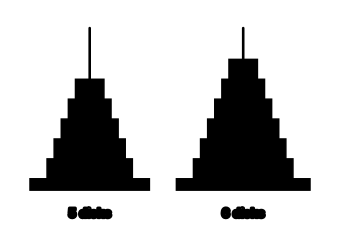
Solving the Tower of Hanoi with 6 disks takes how many more moves than solving it with 5 disks?
Show answerHide answer
Answer: 32
Explanation: Moves for n disks are 2ⁿ − 1: 2⁶ − 1 = 63 for 6 disks and 2⁵ − 1 = 31 for 5 disks, so the difference is 63 − 31 = 32. Subtracting the exponents instead of the move counts gives a meaningless result.
- Q6Hard
What is the sum of all the multiples of 3 from 3 to 99 inclusive?
Show answerHide answer
Answer: 1683
Explanation: The terms 3, 6, …, 99 form an AP with a = 3, d = 3, n = 99÷3 = 33. Sum = n/2×(first + last) = 33/2 × 102 = 1683; using n = 99 instead of 33 would badly overshoot.
Key concepts: Predicting What Comes Next?: Exploring Sequences and Progressions (Class 9 Mathematics)
A sequence is an ordered list of numbers built by a rule. When each term is found by adding a fixed number the sequence is an arithmetic progression; when it is found by multiplying by a fixed number it is a geometric progression. This chapter finds general terms, sums and real-world applications of both.
- Sequence
- An ordered list of numbers following a rule, written a₁, a₂, a₃, … Order matters, so the same numbers in a different order form a different sequence.
- Term and term number
- Each entry is a term; its position n is the term number. aₙ means the nth term, the value in position n.
- Explicit rule
- A formula giving aₙ directly from n, so any term can be found without listing the ones before it.
- Recursive rule
- A rule defining each term from earlier ones, such as aₙ = aₙ₋₁ + aₙ₋₂. It needs starting values before it can generate anything.
- Arithmetic progression (AP)
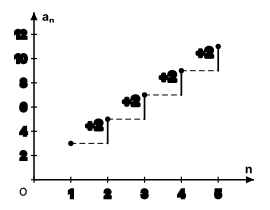
- A sequence in which each term exceeds the previous one by a fixed amount, so the difference between consecutive terms is constant.
- Common difference (d)
- The fixed amount added each time in an AP, found as any term minus the one before it. A negative d makes the sequence decrease.
- nth term of an AP
- aₙ = a + (n − 1)d, where a is the first term. The multiplier is (n − 1), not n, because no difference has been added to the first term.

- Sum of an AP
- The total of the first n terms, obtainable either from the first and last terms or from the first term and common difference.
- Geometric progression (GP)
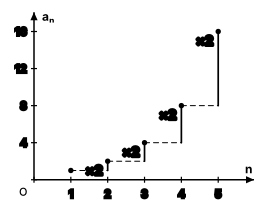
- A sequence in which each term is a fixed multiple of the previous one, so the ratio between consecutive terms is constant.
- Common ratio (r)
- The fixed multiplier in a GP, found by dividing any term by the one before it. If |r| < 1 the terms shrink towards zero.
- nth term of a GP
- aₙ = a·rⁿ⁻¹. Again the exponent is (n − 1), since the first term has not yet been multiplied by r.
- Virahanka–Fibonacci sequence
- The recursive sequence 1, 1, 2, 3, 5, 8, 13, … in which each term is the sum of the previous two. It is neither an AP nor a GP.
- Sum of the first n natural numbers
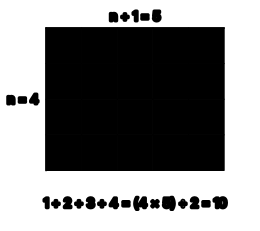
- 1 + 2 + … + n = n(n + 1)/2, the AP sum with a = 1 and d = 1, and a result worth knowing on sight.
- Applications
- APs model quantities changing by a fixed amount — salary increments, saving a set sum monthly — while GPs model repeated multiplication such as population growth or compound interest.
Start this chapter free
You have 6 to try above. Sign in with Google (no card needed). You get 1 Easy + 1 Medium quiz on every chapter, free for good — plus a free Hard quiz when you score 70%+ on a Medium quiz (1 per subject), and the formulas & exam tips.
This chapter has 90 questions (30 Easy · 30 Medium · 30 Hard), with timed scoring and instant feedback. The rest unlock with the ₹999/year plan.
Start this chapter free →Predicting What Comes Next?: Exploring Sequences and Progressions — FAQs
What are the key concepts in Class 9 Mathematics Predicting What Comes Next?: Exploring Sequences and Progressions?+
A sequence is an ordered list of numbers built by a rule. When each term is found by adding a fixed number the sequence is an arithmetic progression; when it is found by multiplying by a fixed number it is a geometric progression. This chapter finds general terms, sums and real-world applications of both. Key ideas include Sequence, Term and term number, Explicit rule, Recursive rule, Arithmetic progression (AP), Common difference (d).
What does Class 9 Mathematics Chapter 8 (Predicting What Comes Next?: Exploring Sequences and Progressions) cover on XamBaaz?+
It has 90 NCERT-based MCQs on "Predicting What Comes Next?: Exploring Sequences and Progressions": 30 Easy, 30 Medium and 30 Hard. Together they make 9 timed quizzes, and you never get the same set twice. Every question has an instant explanation. They help you prepare for CBSE Board exams and the JEE & NEET foundation years.
Are these "Predicting What Comes Next?: Exploring Sequences and Progressions" questions free to practise?+
Yes. Sign in with Google to practise "Predicting What Comes Next?: Exploring Sequences and Progressions" free. Full unlimited access is ₹999/year. One year from the day you pay. You stay in Class 9 till 31 March; on 1 April your account moves up to Class 10 and the rest of your year carries over. No chapter is charged separately.
How should I revise "Predicting What Comes Next?: Exploring Sequences and Progressions" for the exam?+
Start with the Easy quiz to check your basics, then try Medium and Hard to practise applying them. There are 9 timed quizzes on this chapter, so you can come back for a fresh set instead of one you have seen. Read each explanation, retry the questions you miss, and track your accuracy until it stays high.
Are these "Predicting What Comes Next?: Exploring Sequences and Progressions" MCQs available with answers?+
Yes. 6 sample questions are on this page with answers: tap an option, or "Show answer", to see the correct option and a step-by-step explanation. Sign in free with Google to start practising, with instant scoring.
Is there negative marking in the "Predicting What Comes Next?: Exploring Sequences and Progressions" quizzes?+
Yes. The timed quizzes use exam-style marking: +4 for a right answer, −1 for a wrong one and 0 for a skip. MHT-CET and CBSE board papers have no negative marking. Our mocks for those are scored their way.
What are the important questions from Predicting What Comes Next?: Exploring Sequences and Progressions (Class 9 Mathematics)?+
The questions that matter most test Sequence, Term and term number, Explicit rule, Recursive rule, Arithmetic progression (AP), Common difference (d). This page shows 6 solved important MCQs with answers and explanations. Sign in to practise all 90 questions on the chapter as timed quizzes.
Is there an online quiz for Predicting What Comes Next?: Exploring Sequences and Progressions?+
Yes — Class 9 Mathematics Predicting What Comes Next?: Exploring Sequences and Progressions has timed online quizzes at Easy, Medium and Hard levels, with instant scoring and a worked explanation on every question. The first quiz on the chapter is free.