
Exploring Algebraic Identities — Class 9 MCQs with Answers
Class 9 CBSE Mathematics · Chapter 4
11 timed quizzes · Easy, Medium and Hard · Updated
Jump to the 6 solved questions
Practise the most important Class 9 CBSE Mathematics questions from Chapter 4, "Exploring Algebraic Identities". You get 11 timed quizzes of NCERT-based MCQs, with answers and explanations. The questions are split into Easy, Medium and Hard. Warm up on the basics, then move on to the exam-level questions that top scorers in CBSE Board exams and the JEE & NEET foundation years get right.
To score well in "Exploring Algebraic Identities", focus on fast problem-solving, formula recall and step-by-step working. Each MCQ here is timed and uses exam-style marking (+4 correct, −1 wrong, 0 skipped). This helps you stay accurate when time is short, just as real papers need. Every question has a short explanation, so a wrong answer becomes a quick lesson. It is the fastest way to fix gaps before a test.
Use this chapter for focused revision. Start with the Easy set to check your basics on Exploring Algebraic Identities, then move to Medium and Hard to practise applying them. Your accuracy, streaks and XP save automatically. This chapter also adds to your overall Class 9 Mathematics mastery score. Try the 6 sample questions below: tap an option to see the answer and a worked explanation. Sign in free to start practising.
Exploring Algebraic Identities — important questions & MCQs with answers (Class 9 Mathematics)
6 solved questions from this chapter's difficulty levels, each with its answer and explanation. Tap an option to check yourself.
0 of 6 answered
- Q1 of 6Easy
Expand (x + 3)².
Show answerHide answer
Answer: x² + 6x + 9
Explanation: Use (a+b)² = a²+2ab+b² with a=x, b=3: x²+2(x)(3)+3² = x²+6x+9. A common slip is forgetting the middle term and writing x²+9, treating it like a²+b².
- Q2 of 6Easy
Factorise x² − 9.
Show answerHide answer
Answer: (x − 3)(x + 3)
Explanation: x²−9 = x²−3² is a difference of squares, factorising as (x−3)(x+3). Writing (x−3)(x−3) instead would expand back to x²−6x+9, not x²−9.
- Q3 of 6Medium
Simplify (x² − 4)/(x + 2), where x ≠ −2.
Show answerHide answer
Answer: x − 2
Explanation: Factor the numerator: x²−4 = (x−2)(x+2), so dividing by (x+2) cancels that factor and leaves x−2. Cancelling terms without factoring first leads to the wrong x−4.
- Q4 of 6Medium
Assertion (A): A cube of edge (a + b) can be split into two cubes and six cuboids. Reason (R): A square of side (a + b) can be split into two squares of areas a² and b² and two rectangles of area ab each.
Show answerHide answer
Answer: Both A and R are true but R is not the correct explanation of A
Explanation: Both are true. A comes from the cube model of (a + b)³ = a³ + 3a²b + 3ab² + b³. R is the square model of (a + b)², a different picture, so it does not explain A.
- Q5 of 6Hard
Simplify (x² − 9)/(x + 3), where x ≠ −3.
Show answerHide answer
Answer: x − 3
Explanation: Factor the numerator: x²−9 = (x−3)(x+3), so dividing by (x+3) cancels that factor and leaves x−3. Cancelling terms without factoring first leads to the wrong x−9.
- Q6 of 6Hard
Assertion (A): 103 × 97 = 9991. Reason (R): (a − b)² = a² − 2ab + b².
Show answerHide answer
Answer: Both A and R are true but R is not the correct explanation of A
Explanation: Both are true. A uses (a + b)(a − b) = a² − b²: 103 × 97 = 100² − 3² = 10000 − 9 = 9991. R is a different identity, so it does not explain A.
Exploring Algebraic Identities: written board-pattern papers (subjective)
The CBSE board paper tests both objective questions and answers you write out. Alongside the MCQs above, this chapter has 3 written papers in the board pattern, at Easy, Medium and Hard: 30 minutes and 15 marks each, with 2-, 3- and 5-mark questions. Write your answers on paper against the clock, then check them against the step-wise marking scheme, the way a board examiner marks. Objective and subjective together: complete board preparation for this chapter.
Exploring Algebraic Identities: important 3-mark question with answer and marking scheme
Q. Factorise 4x² + 9y² + z² − 12xy − 6yz + 4xz completely. Hence find its value when x = 3, y = 1 and z = 2. (3 marks)
Show answerHide answer
- 4x² = (2x)², 9y² = (−3y)², z² = (z)², so compare with a² + b² + c² + 2ab + 2bc + 2ca taking a = 2x, b = −3y, c = z.1 mark
- Check the middle terms: 2ab = 2(2x)(−3y) = −12xy, 2bc = 2(−3y)(z) = −6yz, 2ca = 2(z)(2x) = 4xz — all match.½ mark
- So 4x² + 9y² + z² − 12xy − 6yz + 4xz = (2x − 3y + z)².½ mark
- At x = 3, y = 1, z = 2: (6 − 3 + 2)² = 5² = 25.1 mark
Answer: (2x − 3y + z)²; value 25. (Equivalently (−2x + 3y − z)²; accept either.)
Where students lose marks: Choosing the sign of 3y wrongly: the two negative terms −12xy and −6yz both contain y, so y alone carries the minus sign.
Exploring Algebraic Identities notes: key concepts (Class 9 Mathematics)
An identity is an equation true for every value of the variable, so it can be used as a shortcut in both directions — to expand a product quickly, or to factorise an expression back into brackets. This chapter builds the square and cube identities, sees them as areas and volumes, and applies them to factorisation.
- Algebraic identity
- An equality that holds for every value of the variables, unlike an equation which holds only for particular values. This is why an identity can be applied to any numbers at all.
- Square of a sum
- (a + b)² expands to a² + 2ab + b². The middle term 2ab is the one most often dropped — squaring does not distribute across addition.
- Square of a difference
- (a − b)² expands to a² − 2ab + b². Only the middle term changes sign, because (−b)² is positive.
- Difference of squares
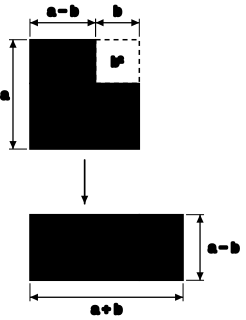
- a² − b² factorises as (a + b)(a − b). It turns awkward products such as 98 × 102 into 100² − 2² instantly.
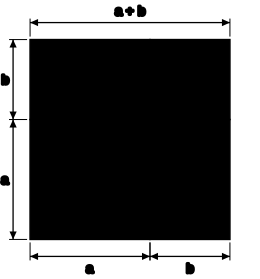
- Area model (visualisation)
- Drawing a square of side (a + b) and splitting it into an a² square, a b² square and two ab rectangles shows geometrically why (a + b)² = a² + 2ab + b².
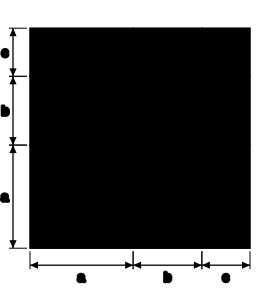
- Square of a trinomial
- (a + b + c)² = a² + b² + c² + 2ab + 2bc + 2ca — each term squared, plus twice every pair product.
- Cube of a sum
- (a + b)³ = a³ + b³ + 3ab(a + b), a compact form that is usually faster than multiplying the bracket out three times.
- Cube of a difference
- (a − b)³ = a³ − b³ − 3ab(a − b), the same structure with alternating signs.
- Sum and difference of cubes
- a³ + b³ = (a + b)(a² − ab + b²) and a³ − b³ = (a − b)(a² + ab + b²). Note the middle sign of the quadratic factor is the opposite of the bracket's.
- Factorisation
- Rewriting an expression as a product. Always take out the highest common factor first, then look for a recognisable identity in what remains.
- Factorising a quadratic by splitting
- For x² + px + q, find two numbers that multiply to q and add to p, split the middle term with them, then group in pairs.
- Factorisation by grouping
- When four terms share no single common factor, group them in pairs, factor each pair, and extract the bracket that both pairs now share.
- Simplifying rational expressions
- Factorise numerator and denominator, then cancel the common factors. Only whole factors cancel, never individual terms of a sum.
Start this chapter free
You have 6 to try above. Sign in with Google (no card needed). You get 1 Easy + 1 Medium quiz on every chapter, free for good (up to 6 quizzes a day) — plus a free Hard quiz when you score 70%+ on a Medium quiz (1 per subject), and the formulas & exam tips.
This chapter has 11 timed quizzes — Easy, Medium and Hard — with timed scoring and instant feedback. The rest unlock with Pro: ₹99/month, or ₹999/year.
Start with the questions above. The full quiz opens here after.
Exploring Algebraic Identities — FAQs
What are the key concepts in Class 9 Mathematics Exploring Algebraic Identities?+
An identity is an equation true for every value of the variable, so it can be used as a shortcut in both directions — to expand a product quickly, or to factorise an expression back into brackets. This chapter builds the square and cube identities, sees them as areas and volumes, and applies them to factorisation. Key ideas include Algebraic identity, Square of a sum, Square of a difference, Difference of squares, Area model (visualisation), Square of a trinomial.
What does Class 9 Mathematics Chapter 4 (Exploring Algebraic Identities) cover on XamBaaz?+
It has 11 timed quizzes of NCERT-based MCQs on "Exploring Algebraic Identities", at Easy, Medium and Hard levels, and you never get the same set twice. Every question has an instant explanation. They help you prepare for CBSE Board exams and the JEE & NEET foundation years.
Are these "Exploring Algebraic Identities" questions free to practise?+
Yes. Sign in with Google to practise "Exploring Algebraic Identities" free. Full unlimited access is ₹999/year. One year from the day you pay. You stay in Class 9 till 31 March; on 1 April your account moves up to Class 10 and the rest of your year carries over. No chapter is charged separately.
How should I revise "Exploring Algebraic Identities" for the exam?+
Start with the Easy quiz to check your basics, then try Medium and Hard to practise applying them. There are 11 timed quizzes on this chapter, so you can come back for a fresh set instead of one you have seen. Read each explanation, retry the questions you miss, and track your accuracy until it stays high.
Are these "Exploring Algebraic Identities" MCQs available with answers?+
Yes. 6 sample questions are on this page with answers: tap an option, or "Show answer", to see the correct option and a step-by-step explanation. Sign in free with Google to start practising, with instant scoring.
Is there negative marking in the "Exploring Algebraic Identities" quizzes?+
Yes. The timed quizzes use exam-style marking: +4 for a right answer, −1 for a wrong one and 0 for a skip. MHT-CET and CBSE board papers have no negative marking. Our mocks for those are scored their way.
What are the important questions from Exploring Algebraic Identities (Class 9 Mathematics)?+
The questions that matter most test Algebraic identity, Square of a sum, Square of a difference, Difference of squares, Area model (visualisation), Square of a trinomial. This page shows 6 solved important MCQs with answers and explanations. Sign in to practise this chapter as timed quizzes.
Is there an online quiz for Exploring Algebraic Identities?+
Yes — Class 9 Mathematics Exploring Algebraic Identities has timed online quizzes at Easy, Medium and Hard levels, with instant scoring and a worked explanation on every question. The first quiz on the chapter is free.
Are there question answers and extra questions for Exploring Algebraic Identities (Class 9 Mathematics)?+
Yes. This page has 6 solved questions on Exploring Algebraic Identities, each with the correct answer and a short explanation. Sign in to practise this chapter as timed quizzes.
Are there assertion–reason and case study questions for Exploring Algebraic Identities (Class 9 Mathematics)?+
Yes. The Exploring Algebraic Identities question bank has assertion–reason questions and case-based (case study) questions in the CBSE board format, alongside the regular MCQs. Each comes with the answer and a worked explanation. Sign in to practise them in timed quizzes.
More Class 9 Mathematics chapters
Class 9 — other subjects
Next year: Class 10 Mathematics important questions & MCQs
🦅 One new exam question every day on Instagram — Follow @xambaaz