
Orienting Yourself: The Use of Coordinates — Class 9 MCQs with Answers
Class 9 CBSE Mathematics · Chapter 1
90 practice questions · 30 Easy · 30 Medium · 30 Hard · Updated
Practise the most important Class 9 CBSE Mathematics questions from Chapter 1, "Orienting Yourself: The Use of Coordinates". You get 9 timed quizzes made from 90 NCERT-based MCQs, with answers and explanations. The questions are split into 30 Easy, 30 Medium and 30 Hard. Warm up on the basics, then move on to the exam-level questions that top scorers in CBSE Board exams and the JEE & NEET foundation years get right.
To score well in "Orienting Yourself: The Use of Coordinates", focus on fast problem-solving, formula recall and step-by-step working. Each MCQ here is timed and uses exam-style marking (+4 correct, −1 wrong, 0 skipped). This helps you stay accurate when time is short, just as real papers need. Every question has a short explanation, so a wrong answer becomes a quick lesson. It is the fastest way to fix gaps before a test.
Use this chapter for focused revision. Start with the Easy set to check your basics on Orienting Yourself: The Use of Coordinates, then move to Medium and Hard to practise applying them. Your accuracy, streaks and XP save automatically. This chapter also adds to your overall Class 9 Mathematics mastery score. Try the 6 sample questions below: tap an option to see the answer and a worked explanation. Sign in free to start practising.
Orienting Yourself: The Use of Coordinates — important questions & MCQs with answers (Class 9 Mathematics)
6 solved questions from this chapter's difficulty levels, each with its answer and explanation. Tap an option to check yourself.
- Q1Easy
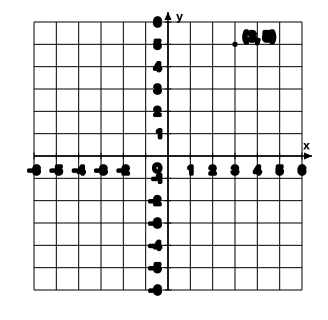
In which quadrant does the point (3, 5) lie?
Show answerHide answer
Answer: Quadrant I
Explanation: A point lies in Quadrant I when both coordinates are positive. Here x=3 and y=5 are both positive, so (3, 5) is in Quadrant I — not Quadrant IV, which needs a negative y.
- Q2Easy
What is the abscissa of the point (6, -2)?
Show answerHide answer
Answer: 6
Explanation: The abscissa is the first coordinate, the x-value. For (6, -2) that is 6 — not -2, which is the ordinate (y-value), a common mix-up between the two terms.
- Q3Medium
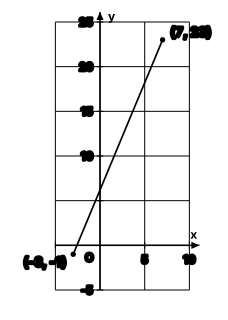
Find the distance between the points (-3, -1) and (7, 23).
Show answerHide answer
Answer: 26 units
Explanation: Distance = √((7--3)²+(23--1)²) = √(10²+24²) = √676 = 26 units. Adding the two gaps instead, 10+24=34, gives the path along the legs, not the diagonal distance.
- Q4Medium
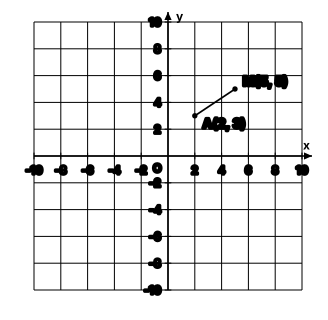
If M(5, 5) is the midpoint of A(2, 3) and B, find B.
Show answerHide answer
Answer: (8, 7)
Explanation: Since M is the midpoint of A and B, doubling M and subtracting A recovers the far endpoint: B=(2·5−2, 2·5−3)=(8, 7). Flipping every sign instead would give the wrong point (-8, -7).
- Q5Hard
Are the points (1, 1), (2, 3), (3, 5) collinear?
Show answerHide answer
Answer: Collinear — the slope is 2 throughout
Explanation: Check whether the slope stays constant between consecutive points: from (1,1) to (2,3) it's (3-1)/(2-1)=2, and from (2,3) to (3,5) it's also 2 — equal slopes mean the three points are collinear.
- Q6Hard
Classify the triangle with vertices (0, 0), (4, 0) and (0, 3) by its sides.
Show answerHide answer
Answer: scalene
Explanation: Computing each side with the distance formula gives lengths 4, 5 and 3 — all different, so the triangle is scalene. It does have a right angle (3² + 4² = 5²), but no two sides are equal, so it is not an isosceles right triangle.
Key concepts: Orienting Yourself: The Use of Coordinates (Class 9 Mathematics)
Coordinates turn geometry into arithmetic: fix two perpendicular number lines and every point in the plane gets a unique address (x, y). Once points have addresses, distance, midpoints, collinearity and the shape of a figure can all be settled by calculation instead of measurement.
- Cartesian plane
- The flat plane formed by two perpendicular number lines — the horizontal x-axis and the vertical y-axis — which together let any point be located exactly.
- Origin
- The point (0, 0) where the two axes cross. All coordinates are measured as displacements from here, so it is the reference point of the whole system.
- Coordinates (ordered pair)
- The pair (x, y) giving a point's address: x is the abscissa (horizontal displacement) and y the ordinate (vertical). The order matters — (3, 5) and (5, 3) are different points.
- Quadrants
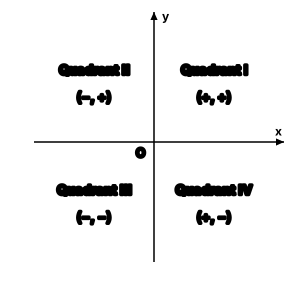
- The axes cut the plane into four regions, numbered anticlockwise from the top right, with sign patterns (+, +), (−, +), (−, −) and (+, −). The signs alone tell you the quadrant.
- Points on the axes
- A point on the x-axis has y = 0 and looks like (a, 0); a point on the y-axis has x = 0 and looks like (0, b). Points on an axis belong to no quadrant.
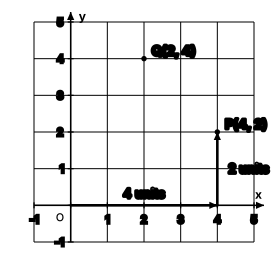
- Plotting a point
- Move x units along the x-axis from the origin, then y units parallel to the y-axis. Reversing the order lands you somewhere else entirely.
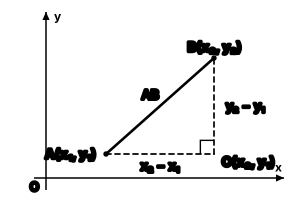
- Distance formula
- The straight-line distance between two points, obtained by applying Pythagoras to the horizontal and vertical gaps between them.
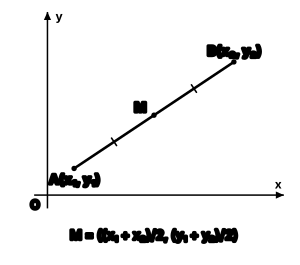
- Midpoint
- The point exactly halfway along a segment; its coordinates are the averages of the two endpoints' coordinates.
- Collinear points
- Three points lying on one straight line. Test by distances: if AB + BC = AC, then B lies between A and C and all three are collinear.
- Equidistant point
- A point the same distance from two others. Setting the two distance expressions equal and squaring both sides gives an equation the point must satisfy.
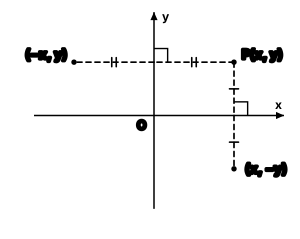
- Reflection in an axis
- Reflecting across the x-axis flips the sign of y, giving (x, −y); reflecting across the y-axis flips the sign of x, giving (−x, y).
- Identifying a figure from coordinates
- Compute side lengths and diagonals: equal opposite sides mean a parallelogram, all four sides equal a rhombus, and equal diagonals distinguish a rectangle or square.
Start this chapter free
You have 6 to try above. Sign in with Google (no card needed). You get 1 Easy + 1 Medium quiz on every chapter, free for good — plus a free Hard quiz when you score 70%+ on a Medium quiz (1 per subject), and the formulas & exam tips.
This chapter has 90 questions (30 Easy · 30 Medium · 30 Hard), with timed scoring and instant feedback. The rest unlock with the ₹999/year plan.
Start this chapter free →Orienting Yourself: The Use of Coordinates — FAQs
What are the key concepts in Class 9 Mathematics Orienting Yourself: The Use of Coordinates?+
Coordinates turn geometry into arithmetic: fix two perpendicular number lines and every point in the plane gets a unique address (x, y). Once points have addresses, distance, midpoints, collinearity and the shape of a figure can all be settled by calculation instead of measurement. Key ideas include Cartesian plane, Origin, Coordinates (ordered pair), Quadrants, Points on the axes, Plotting a point.
What does Class 9 Mathematics Chapter 1 (Orienting Yourself: The Use of Coordinates) cover on XamBaaz?+
It has 90 NCERT-based MCQs on "Orienting Yourself: The Use of Coordinates": 30 Easy, 30 Medium and 30 Hard. Together they make 9 timed quizzes, and you never get the same set twice. Every question has an instant explanation. They help you prepare for CBSE Board exams and the JEE & NEET foundation years.
Are these "Orienting Yourself: The Use of Coordinates" questions free to practise?+
Yes. Sign in with Google to practise "Orienting Yourself: The Use of Coordinates" free. Full unlimited access is ₹999/year. One year from the day you pay. You stay in Class 9 till 31 March; on 1 April your account moves up to Class 10 and the rest of your year carries over. No chapter is charged separately.
How should I revise "Orienting Yourself: The Use of Coordinates" for the exam?+
Start with the Easy quiz to check your basics, then try Medium and Hard to practise applying them. There are 9 timed quizzes on this chapter, so you can come back for a fresh set instead of one you have seen. Read each explanation, retry the questions you miss, and track your accuracy until it stays high.
Are these "Orienting Yourself: The Use of Coordinates" MCQs available with answers?+
Yes. 6 sample questions are on this page with answers: tap an option, or "Show answer", to see the correct option and a step-by-step explanation. Sign in free with Google to start practising, with instant scoring.
Is there negative marking in the "Orienting Yourself: The Use of Coordinates" quizzes?+
Yes. The timed quizzes use exam-style marking: +4 for a right answer, −1 for a wrong one and 0 for a skip. MHT-CET and CBSE board papers have no negative marking. Our mocks for those are scored their way.
What are the important questions from Orienting Yourself: The Use of Coordinates (Class 9 Mathematics)?+
The questions that matter most test Cartesian plane, Origin, Coordinates (ordered pair), Quadrants, Points on the axes, Plotting a point. This page shows 6 solved important MCQs with answers and explanations. Sign in to practise all 90 questions on the chapter as timed quizzes.
Is there an online quiz for Orienting Yourself: The Use of Coordinates?+
Yes — Class 9 Mathematics Orienting Yourself: The Use of Coordinates has timed online quizzes at Easy, Medium and Hard levels, with instant scoring and a worked explanation on every question. The first quiz on the chapter is free.