
Measuring Space: Perimeter and Area — Class 9 MCQs with Answers
Class 9 CBSE Mathematics · Chapter 6
90 practice questions · 30 Easy · 30 Medium · 30 Hard · Updated
Practise the most important Class 9 CBSE Mathematics questions from Chapter 6, "Measuring Space: Perimeter and Area". You get 9 timed quizzes made from 90 NCERT-based MCQs, with answers and explanations. The questions are split into 30 Easy, 30 Medium and 30 Hard. Warm up on the basics, then move on to the exam-level questions that top scorers in CBSE Board exams and the JEE & NEET foundation years get right.
To score well in "Measuring Space: Perimeter and Area", focus on fast problem-solving, formula recall and step-by-step working. Each MCQ here is timed and uses exam-style marking (+4 correct, −1 wrong, 0 skipped). This helps you stay accurate when time is short, just as real papers need. Every question has a short explanation, so a wrong answer becomes a quick lesson. It is the fastest way to fix gaps before a test.
Use this chapter for focused revision. Start with the Easy set to check your basics on Measuring Space: Perimeter and Area, then move to Medium and Hard to practise applying them. Your accuracy, streaks and XP save automatically. This chapter also adds to your overall Class 9 Mathematics mastery score. Try the 6 sample questions below: tap an option to see the answer and a worked explanation. Sign in free to start practising.
Measuring Space: Perimeter and Area — important questions & MCQs with answers (Class 9 Mathematics)
6 solved questions from this chapter's difficulty levels, each with its answer and explanation. Tap an option to check yourself.
- Q1Easy
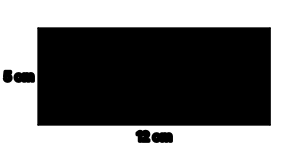
Find the area of a rectangle 12 cm by 5 cm.
Show answerHide answer
Answer: 60 cm²
Explanation: Area of a rectangle = length × breadth = 12 × 5 = 60 cm². Adding the sides gives 17 cm², and doubling that (the perimeter) gives 34 cm² — both add the sides instead of multiplying them.
- Q2Easy
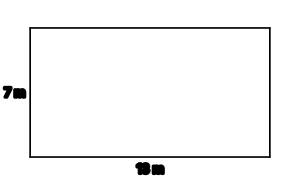
Find the perimeter of a rectangle 13 m by 7 m.
Show answerHide answer
Answer: 40 m
Explanation: Perimeter = 2(length+breadth) = 2(13+7) = 40 m. Forgetting to double the sum gives just 20 m, and multiplying the sides instead gives the area, 91 m² — neither is the perimeter.
- Q3Medium
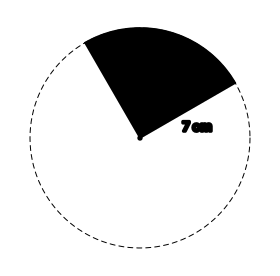
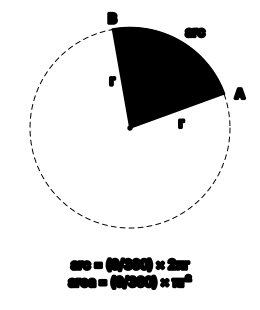
Find the area of a sector of a circle of radius 7 cm with central angle 90°. (Take π = 22/7.)
Show answerHide answer
Answer: 38.5 cm²
Explanation: Sector area = (θ/360)×πr² = (90/360) × 22/7 × 7² = 38.5 cm². Forgetting the θ/360 fraction gives the full circle's area, 154 cm², instead of just the 90° slice.
- Q4Medium
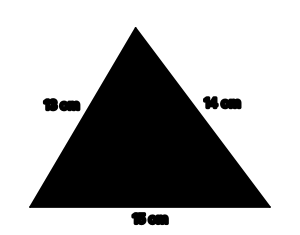
Using Heron's formula, find the area of a triangle with sides 13 cm, 14 cm and 15 cm.
Show answerHide answer
Answer: 84 cm²
Explanation: Heron's formula: s = (13+14+15)/2 = 21 cm. Area = √(s(s−a)(s−b)(s−c)) = √(21×8×7×6) = 84 cm². Using the full perimeter, 42 cm, as s instead of halving it is the usual slip.
- Q5Hard
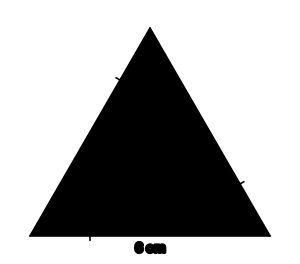
Find the area of an equilateral triangle of side 6 cm (leave the answer in surd form).
Show answerHide answer
Answer: 9√3 cm²
Explanation: Area of an equilateral triangle = (√3/4)×a² = (√3/4)×6² = 9√3 cm². Dropping the √3 gives just 9 (a plain number), and forgetting to divide by 4 gives 36√3 instead.
- Q6Hard
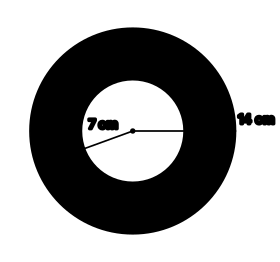
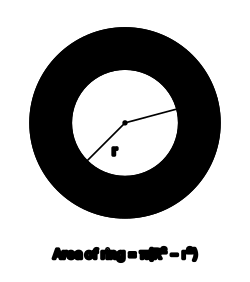
A circular ring has outer radius 14 cm and inner radius 7 cm. Find the area of the ring. (π = 22/7.)
Show answerHide answer
Answer: 462 cm²
Explanation: Ring area = π(R²−r²) = 22/7×(14²−7²) = 22/7×147 = 462 cm². Squaring the difference of radii instead, π(14−7)² = 154 cm², undercounts badly — subtract the squares, don't square the subtraction.
Key concepts: Measuring Space: Perimeter and Area (Class 9 Mathematics)
Perimeter measures the boundary of a figure and area the space inside it. This chapter gathers the area formulas for the standard polygons, adds Heron's formula for a triangle from its three sides and Brahmagupta's formula for a cyclic quadrilateral, and handles circles, sectors and composite shapes.
- Perimeter
- The total length of the boundary of a closed figure, measured in units of length. For a circle the boundary length is called the circumference.
- Area
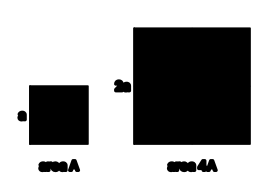
- The amount of surface a figure encloses, measured in square units. Doubling every length multiplies the area by four, not by two.
- Area of a triangle (base and height)
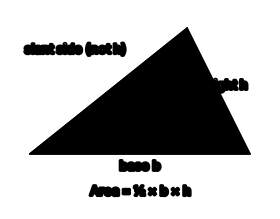
- Half the base times the perpendicular height. The height must be perpendicular to the chosen base, not the slanted side.
- Heron's formula
- Gives a triangle's area from its three sides alone, using the semi-perimeter s. Essential when no height is known or easily found.
- Semi-perimeter
- Half the perimeter, written s. It is the quantity both Heron's and Brahmagupta's formulas are built from.
- Area of an equilateral triangle
- A special case worth memorising: (√3/4) × side², which is far quicker than applying Heron's formula each time.
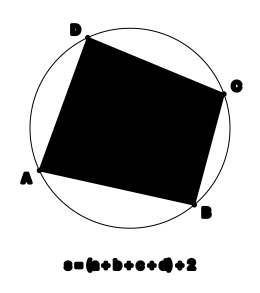
- Brahmagupta's formula
- Gives the area of a cyclic quadrilateral from its four sides, using the semi-perimeter. It reduces to Heron's formula when one side shrinks to zero.
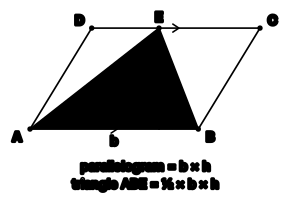
- Area of a parallelogram
- Base times perpendicular height. A parallelogram and a triangle on the same base and between the same parallels are related by a factor of two.
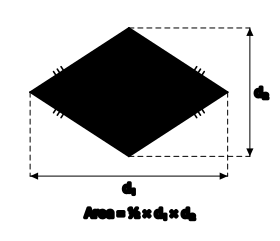
- Area of a rhombus
- Half the product of its diagonals, since the diagonals of a rhombus bisect each other at right angles.
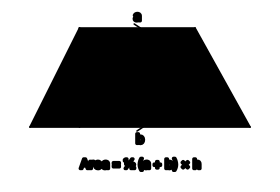
- Area of a trapezium
- Half the sum of the two parallel sides, multiplied by the distance between them.
- Circumference and area of a circle
- Circumference is 2πr and area is πr². Confusing the two is easy — one is a length, the other a square measure.
- Sector of a circle
- A slice bounded by two radii and an arc. Its arc length and area are the fraction θ/360 of the whole circle's.
- Annulus (ring)
- The region between two concentric circles; its area is the outer circle's area minus the inner one's, π(R² − r²).
- Composite figures
- Shapes built from standard pieces. Split them into known figures and add, or subtract a removed piece from a surrounding shape.
Start this chapter free
You have 6 to try above. Sign in with Google (no card needed). You get 1 Easy + 1 Medium quiz on every chapter, free for good — plus a free Hard quiz when you score 70%+ on a Medium quiz (1 per subject), and the formulas & exam tips.
This chapter has 90 questions (30 Easy · 30 Medium · 30 Hard), with timed scoring and instant feedback. The rest unlock with the ₹999/year plan.
Start this chapter free →Measuring Space: Perimeter and Area — FAQs
What are the key concepts in Class 9 Mathematics Measuring Space: Perimeter and Area?+
Perimeter measures the boundary of a figure and area the space inside it. This chapter gathers the area formulas for the standard polygons, adds Heron's formula for a triangle from its three sides and Brahmagupta's formula for a cyclic quadrilateral, and handles circles, sectors and composite shapes. Key ideas include Perimeter, Area, Area of a triangle (base and height), Heron's formula, Semi-perimeter, Area of an equilateral triangle.
What does Class 9 Mathematics Chapter 6 (Measuring Space: Perimeter and Area) cover on XamBaaz?+
It has 90 NCERT-based MCQs on "Measuring Space: Perimeter and Area": 30 Easy, 30 Medium and 30 Hard. Together they make 9 timed quizzes, and you never get the same set twice. Every question has an instant explanation. They help you prepare for CBSE Board exams and the JEE & NEET foundation years.
Are these "Measuring Space: Perimeter and Area" questions free to practise?+
Yes. Sign in with Google to practise "Measuring Space: Perimeter and Area" free. Full unlimited access is ₹999/year. One year from the day you pay. You stay in Class 9 till 31 March; on 1 April your account moves up to Class 10 and the rest of your year carries over. No chapter is charged separately.
How should I revise "Measuring Space: Perimeter and Area" for the exam?+
Start with the Easy quiz to check your basics, then try Medium and Hard to practise applying them. There are 9 timed quizzes on this chapter, so you can come back for a fresh set instead of one you have seen. Read each explanation, retry the questions you miss, and track your accuracy until it stays high.
Are these "Measuring Space: Perimeter and Area" MCQs available with answers?+
Yes. 6 sample questions are on this page with answers: tap an option, or "Show answer", to see the correct option and a step-by-step explanation. Sign in free with Google to start practising, with instant scoring.
Is there negative marking in the "Measuring Space: Perimeter and Area" quizzes?+
Yes. The timed quizzes use exam-style marking: +4 for a right answer, −1 for a wrong one and 0 for a skip. MHT-CET and CBSE board papers have no negative marking. Our mocks for those are scored their way.
What are the important questions from Measuring Space: Perimeter and Area (Class 9 Mathematics)?+
The questions that matter most test Perimeter, Area, Area of a triangle (base and height), Heron's formula, Semi-perimeter, Area of an equilateral triangle. This page shows 6 solved important MCQs with answers and explanations. Sign in to practise all 90 questions on the chapter as timed quizzes.
Is there an online quiz for Measuring Space: Perimeter and Area?+
Yes — Class 9 Mathematics Measuring Space: Perimeter and Area has timed online quizzes at Easy, Medium and Hard levels, with instant scoring and a worked explanation on every question. The first quiz on the chapter is free.