
The Mathematics of Maybe: Introduction to Probability — Class 9 MCQs with Answers
Class 9 CBSE Mathematics · Chapter 7
90 practice questions · 30 Easy · 30 Medium · 30 Hard · Updated
Practise the most important Class 9 CBSE Mathematics questions from Chapter 7, "The Mathematics of Maybe: Introduction to Probability". You get 9 timed quizzes made from 90 NCERT-based MCQs, with answers and explanations. The questions are split into 30 Easy, 30 Medium and 30 Hard. Warm up on the basics, then move on to the exam-level questions that top scorers in CBSE Board exams and the JEE & NEET foundation years get right.
To score well in "The Mathematics of Maybe: Introduction to Probability", focus on fast problem-solving, formula recall and step-by-step working. Each MCQ here is timed and uses exam-style marking (+4 correct, −1 wrong, 0 skipped). This helps you stay accurate when time is short, just as real papers need. Every question has a short explanation, so a wrong answer becomes a quick lesson. It is the fastest way to fix gaps before a test.
Use this chapter for focused revision. Start with the Easy set to check your basics on The Mathematics of Maybe: Introduction to Probability, then move to Medium and Hard to practise applying them. Your accuracy, streaks and XP save automatically. This chapter also adds to your overall Class 9 Mathematics mastery score. Try the 6 sample questions below: tap an option to see the answer and a worked explanation. Sign in free to start practising.
The Mathematics of Maybe: Introduction to Probability — important questions & MCQs with answers (Class 9 Mathematics)
6 solved questions from this chapter's difficulty levels, each with its answer and explanation. Tap an option to check yourself.
- Q1Easy
A fair coin is tossed once. What is the probability of getting a head?
Show answerHide answer
Answer: 1/2
Explanation: Probability = favourable ÷ total outcomes. A coin has 2 equally likely outcomes and 1 is heads, so P(head) = 1/2 — not 1, since heads isn't guaranteed on a single toss.
- Q2Easy
What is the probability of a certain (sure) event?
Show answerHide answer
Answer: 1
Explanation: A certain event is guaranteed to happen every time, so its probability sits at the maximum value, 1 — never a fraction like 1/2, which would mean it sometimes fails to occur.
- Q3Medium
Two coins are tossed together. What is the probability of getting at least one head?
Show answerHide answer
Answer: 3/4
Explanation: The complement is easier here: P(at least one head) = 1 − P(no head) = 1 − P(TT) = 1 − 1/4 = 3/4, since only 1 of the 4 outcomes {HH, HT, TH, TT} has zero heads.
- Q4Medium
A coin was tossed 100 times and a head appeared 45 times. What is the empirical probability of getting a head?
Show answerHide answer
Answer: 9/20
Explanation: Empirical probability = favourable trials ÷ total trials actually performed, not a theoretical count. Here 45 heads out of 100 tosses gives 45/100 = 9/20, distinct from the theoretical 1/2.
- Q5Hard
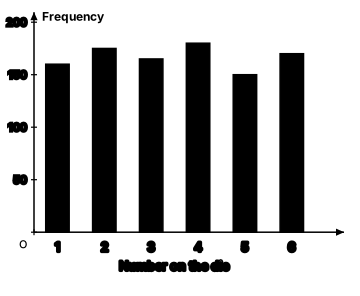
A die was thrown 1000 times with these frequencies — 1: 160, 2: 175, 3: 165, 4: 180, 5: 150, 6: 170. What is the empirical probability of getting a 4?
Show answerHide answer
Answer: 0.18
Explanation: Empirical probability = (frequency of the outcome) ÷ (total trials) = 180/1000 = 0.18. Reading a different row's frequency from the table, like 175 or 170, would give the wrong value.
- Q6Hard
A card is drawn from 52 cards. What is the probability that it is a face card or an ace?
Show answerHide answer
Answer: 4/13
Explanation: Combine without double-counting: 12 face cards plus 4 aces (aces aren't face cards, so no overlap) = 16 cards out of 52, giving P = 16/52 = 4/13.
Key concepts: The Mathematics of Maybe: Introduction to Probability (Class 9 Mathematics)
Probability puts a number between 0 and 1 on how likely an event is. This chapter distinguishes empirical probability, measured from trials actually performed, from theoretical probability, calculated from equally likely outcomes, and uses sample spaces and tree diagrams to count outcomes for compound experiments.
- Random experiment
- An action whose individual result cannot be predicted in advance, though all the possible results are known — tossing a coin or rolling a die.
- Outcome and event
- An outcome is a single possible result; an event is a collection of outcomes we are interested in, such as 'an even number' when rolling a die.
- Sample space
- The set of every possible outcome of an experiment. Listing it correctly is the essential first step, since it supplies the denominator.
- Empirical (experimental) probability
- Found by actually performing trials: the number of times the event happened divided by the total number of trials. It changes from one set of trials to another.
- Theoretical probability
- Calculated without experimenting, as favourable outcomes divided by total equally likely outcomes. It is fixed for a given experiment.
- Equally likely outcomes
- Outcomes with the same chance of occurring, as on a fair die. Theoretical probability is only valid when this assumption genuinely holds.
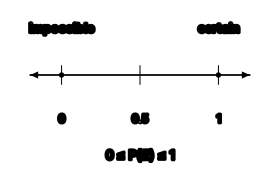
- Probability scale
- Every probability lies between 0 and 1 inclusive. An impossible event has probability 0 and a certain event has probability 1.
- Complement of an event
- The event 'not E'. Since one of E and not-E must happen, P(E) + P(not E) = 1, which often gives the quickest route to an answer.

- Sum of all probabilities
- The probabilities of all the distinct outcomes of an experiment always add up to exactly 1 — a useful check on any table of values.
- Compound experiment
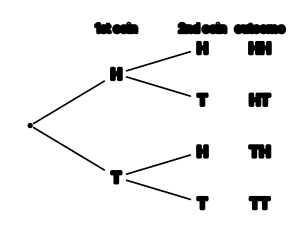
- An experiment made of more than one action, such as tossing two coins or rolling a die twice. The sample space grows multiplicatively.
- Tree diagram
- A branching diagram listing the outcomes of each stage in turn, ensuring no outcome of a compound experiment is missed or double-counted.
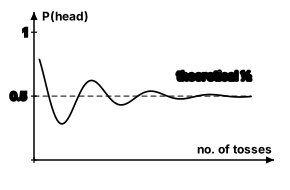
- Convergence to theoretical probability
- As the number of trials grows large, empirical probability tends to settle near the theoretical value — the reason a few tosses prove nothing.
- Playing-card deck
- A standard pack of 52 cards: 4 suits of 13, with 26 red and 26 black, 12 face cards, and 4 aces — the counts most card questions depend on.
Start this chapter free
You have 6 to try above. Sign in with Google (no card needed). You get 1 Easy + 1 Medium quiz on every chapter, free for good — plus a free Hard quiz when you score 70%+ on a Medium quiz (1 per subject), and the formulas & exam tips.
This chapter has 90 questions (30 Easy · 30 Medium · 30 Hard), with timed scoring and instant feedback. The rest unlock with the ₹999/year plan.
Start this chapter free →The Mathematics of Maybe: Introduction to Probability — FAQs
What are the key concepts in Class 9 Mathematics The Mathematics of Maybe: Introduction to Probability?+
Probability puts a number between 0 and 1 on how likely an event is. This chapter distinguishes empirical probability, measured from trials actually performed, from theoretical probability, calculated from equally likely outcomes, and uses sample spaces and tree diagrams to count outcomes for compound experiments. Key ideas include Random experiment, Outcome and event, Sample space, Empirical (experimental) probability, Theoretical probability, Equally likely outcomes.
What does Class 9 Mathematics Chapter 7 (The Mathematics of Maybe: Introduction to Probability) cover on XamBaaz?+
It has 90 NCERT-based MCQs on "The Mathematics of Maybe: Introduction to Probability": 30 Easy, 30 Medium and 30 Hard. Together they make 9 timed quizzes, and you never get the same set twice. Every question has an instant explanation. They help you prepare for CBSE Board exams and the JEE & NEET foundation years.
Are these "The Mathematics of Maybe: Introduction to Probability" questions free to practise?+
Yes. Sign in with Google to practise "The Mathematics of Maybe: Introduction to Probability" free. Full unlimited access is ₹999/year. One year from the day you pay. You stay in Class 9 till 31 March; on 1 April your account moves up to Class 10 and the rest of your year carries over. No chapter is charged separately.
How should I revise "The Mathematics of Maybe: Introduction to Probability" for the exam?+
Start with the Easy quiz to check your basics, then try Medium and Hard to practise applying them. There are 9 timed quizzes on this chapter, so you can come back for a fresh set instead of one you have seen. Read each explanation, retry the questions you miss, and track your accuracy until it stays high.
Are these "The Mathematics of Maybe: Introduction to Probability" MCQs available with answers?+
Yes. 6 sample questions are on this page with answers: tap an option, or "Show answer", to see the correct option and a step-by-step explanation. Sign in free with Google to start practising, with instant scoring.
Is there negative marking in the "The Mathematics of Maybe: Introduction to Probability" quizzes?+
Yes. The timed quizzes use exam-style marking: +4 for a right answer, −1 for a wrong one and 0 for a skip. MHT-CET and CBSE board papers have no negative marking. Our mocks for those are scored their way.
What are the important questions from The Mathematics of Maybe: Introduction to Probability (Class 9 Mathematics)?+
The questions that matter most test Random experiment, Outcome and event, Sample space, Empirical (experimental) probability, Theoretical probability, Equally likely outcomes. This page shows 6 solved important MCQs with answers and explanations. Sign in to practise all 90 questions on the chapter as timed quizzes.
Is there an online quiz for The Mathematics of Maybe: Introduction to Probability?+
Yes — Class 9 Mathematics The Mathematics of Maybe: Introduction to Probability has timed online quizzes at Easy, Medium and Hard levels, with instant scoring and a worked explanation on every question. The first quiz on the chapter is free.