
The World of Numbers — Class 9 MCQs with Answers
Class 9 CBSE Mathematics · Chapter 3
90 practice questions · 30 Easy · 30 Medium · 30 Hard · Updated
Practise the most important Class 9 CBSE Mathematics questions from Chapter 3, "The World of Numbers". You get 9 timed quizzes made from 90 NCERT-based MCQs, with answers and explanations. The questions are split into 30 Easy, 30 Medium and 30 Hard. Warm up on the basics, then move on to the exam-level questions that top scorers in CBSE Board exams and the JEE & NEET foundation years get right.
To score well in "The World of Numbers", focus on fast problem-solving, formula recall and step-by-step working. Each MCQ here is timed and uses exam-style marking (+4 correct, −1 wrong, 0 skipped). This helps you stay accurate when time is short, just as real papers need. Every question has a short explanation, so a wrong answer becomes a quick lesson. It is the fastest way to fix gaps before a test.
Use this chapter for focused revision. Start with the Easy set to check your basics on The World of Numbers, then move to Medium and Hard to practise applying them. Your accuracy, streaks and XP save automatically. This chapter also adds to your overall Class 9 Mathematics mastery score. Try the 6 sample questions below: tap an option to see the answer and a worked explanation. Sign in free to start practising.
The World of Numbers — important questions & MCQs with answers (Class 9 Mathematics)
6 solved questions from this chapter's difficulty levels, each with its answer and explanation. Tap an option to check yourself.
- Q1Easy
Which of the following is a rational number?
Show answerHide answer
Answer: √16
Explanation: √16 = 4 because 16 is a perfect square (4×4=16), and 4 = 4/1 is rational. √2, √5 and π have no exact root, so their decimals never terminate or repeat — irrational.
- Q2Easy
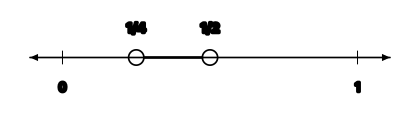
Which of the following lies between 1/4 and 1/2?
Show answerHide answer
Answer: 3/8
Explanation: 1/4 = 0.25 and 1/2 = 0.5, and 3/8 = 0.375 sits strictly between them. 1/8 = 0.125 is below 1/4, while 5/8 and 3/4 are both above 1/2.
- Q3Medium
Express 0.777… (0.7 repeating) as a fraction in lowest terms.
Show answerHide answer
Answer: 7/9
Explanation: Let x = 0.777…; then 10x = 7.777…, so 9x = 7 and x = 7/9 in lowest terms — not 70/99, which is 0.7070… (a two-digit repeating block).
- Q4Medium
Which of the following is an irrational number?
Show answerHide answer
Answer: √2 + √3
Explanation: √16 = 4, √2×√8 = √16 = 4, and (√3)² = 3 are all whole numbers, hence rational. √2 + √3 cannot simplify to a whole number or fraction, so it stays irrational.
- Q5Hard
Simplify 1/(√3 − √2) + 1/(√3 + √2).
Show answerHide answer
Answer: 2√3
Explanation: Rationalising each term separately gives (√3+√2)/(3−2) = √3+√2 and (√3−√2)/(3−2) = √3−√2; adding these makes the √2 parts cancel, leaving 2√3, not 2√2.
- Q6Hard
The fraction, in lowest terms, equal to 0.123123123… is:
Show answerHide answer
Answer: 41/333
Explanation: The 3-digit repeating block gives 0.123123… = 123/999; dividing both by their common factor 3 gives 41/333 in lowest terms — 123/990 uses the wrong denominator for a 3-digit repeat.
Key concepts: The World of Numbers (Class 9 Mathematics)
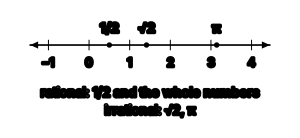
This chapter completes the number line. Rational numbers are dense but leave gaps; those gaps are filled by irrationals such as √2 and π, and together the two form the real numbers. It also covers converting decimals to fractions, rationalising denominators and the laws of exponents.
- Rational number
- Any number expressible as p/q with p and q integers and q ≠ 0. Every integer qualifies, since n can be written n/1.
- Irrational number
- A number that cannot be written as p/q, such as √2, √3 and π. Its decimal expansion never terminates and never settles into a repeating block.
- Real numbers
- The rationals and irrationals together. Every real number corresponds to exactly one point on the number line, and every point to one real number.
- Density of rationals
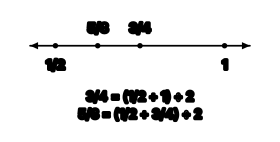
- Between any two distinct rational numbers there is another rational — their mean, for instance — so infinitely many rationals lie between any two.
- Terminating decimal
- A decimal that stops, such as 0.75. A fraction in lowest terms terminates exactly when its denominator's only prime factors are 2 and 5.
- Recurring decimal
- A decimal in which a block of digits repeats forever, written with a bar, as in 0.3̄. Every rational number is either terminating or recurring.
- Decimal to p/q form
- A terminating decimal is written over the matching power of 10 and reduced; a recurring decimal is converted by multiplying by a power of 10 and subtracting to cancel the repeating block.
- Surd
- An irrational root left in root form, such as √5. Surds are kept exact rather than rounded, so answers stay precise.
- Rationalising the denominator
- Removing a root from the denominator by multiplying numerator and denominator by a suitable factor — for √a by √a, and for a binomial by its conjugate.
- Conjugate
- The partner expression obtained by flipping the middle sign, so the conjugate of √5 − 2 is √5 + 2. Multiplying them gives a difference of squares with no root left.
- Operations and closure
- Rationals are closed under addition, subtraction, multiplication and division by a non-zero number. Irrationals are not: √2 × √2 = 2 is rational.
- Laws of exponents
- Rules for combining powers with the same base — add exponents when multiplying, subtract when dividing, multiply when raising a power to a power.
- Representing roots on the number line
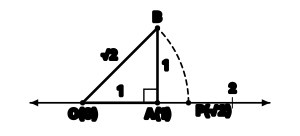
- A length such as √2 is constructed geometrically as the hypotenuse of a right triangle with legs 1 and 1, then transferred to the line with compasses.
Start this chapter free
You have 6 to try above. Sign in with Google (no card needed). You get 1 Easy + 1 Medium quiz on every chapter, free for good — plus a free Hard quiz when you score 70%+ on a Medium quiz (1 per subject), and the formulas & exam tips.
This chapter has 90 questions (30 Easy · 30 Medium · 30 Hard), with timed scoring and instant feedback. The rest unlock with the ₹999/year plan.
Start this chapter free →The World of Numbers — FAQs
What are the key concepts in Class 9 Mathematics The World of Numbers?+
This chapter completes the number line. Rational numbers are dense but leave gaps; those gaps are filled by irrationals such as √2 and π, and together the two form the real numbers. It also covers converting decimals to fractions, rationalising denominators and the laws of exponents. Key ideas include Rational number, Irrational number, Real numbers, Density of rationals, Terminating decimal, Recurring decimal.
What does Class 9 Mathematics Chapter 3 (The World of Numbers) cover on XamBaaz?+
It has 90 NCERT-based MCQs on "The World of Numbers": 30 Easy, 30 Medium and 30 Hard. Together they make 9 timed quizzes, and you never get the same set twice. Every question has an instant explanation. They help you prepare for CBSE Board exams and the JEE & NEET foundation years.
Are these "The World of Numbers" questions free to practise?+
Yes. Sign in with Google to practise "The World of Numbers" free. Full unlimited access is ₹999/year. One year from the day you pay. You stay in Class 9 till 31 March; on 1 April your account moves up to Class 10 and the rest of your year carries over. No chapter is charged separately.
How should I revise "The World of Numbers" for the exam?+
Start with the Easy quiz to check your basics, then try Medium and Hard to practise applying them. There are 9 timed quizzes on this chapter, so you can come back for a fresh set instead of one you have seen. Read each explanation, retry the questions you miss, and track your accuracy until it stays high.
Are these "The World of Numbers" MCQs available with answers?+
Yes. 6 sample questions are on this page with answers: tap an option, or "Show answer", to see the correct option and a step-by-step explanation. Sign in free with Google to start practising, with instant scoring.
Is there negative marking in the "The World of Numbers" quizzes?+
Yes. The timed quizzes use exam-style marking: +4 for a right answer, −1 for a wrong one and 0 for a skip. MHT-CET and CBSE board papers have no negative marking. Our mocks for those are scored their way.
What are the important questions from The World of Numbers (Class 9 Mathematics)?+
The questions that matter most test Rational number, Irrational number, Real numbers, Density of rationals, Terminating decimal, Recurring decimal. This page shows 6 solved important MCQs with answers and explanations. Sign in to practise all 90 questions on the chapter as timed quizzes.
Is there an online quiz for The World of Numbers?+
Yes — Class 9 Mathematics The World of Numbers has timed online quizzes at Easy, Medium and Hard levels, with instant scoring and a worked explanation on every question. The first quiz on the chapter is free.