
I'm Up and Down, and Round and Round — Class 9 MCQs with Answers
Class 9 CBSE Mathematics · Chapter 5
90 practice questions · 30 Easy · 30 Medium · 30 Hard · Updated
Practise the most important Class 9 CBSE Mathematics questions from Chapter 5, "I'm Up and Down, and Round and Round". You get 9 timed quizzes made from 90 NCERT-based MCQs, with answers and explanations. The questions are split into 30 Easy, 30 Medium and 30 Hard. Warm up on the basics, then move on to the exam-level questions that top scorers in CBSE Board exams and the JEE & NEET foundation years get right.
To score well in "I'm Up and Down, and Round and Round", focus on fast problem-solving, formula recall and step-by-step working. Each MCQ here is timed and uses exam-style marking (+4 correct, −1 wrong, 0 skipped). This helps you stay accurate when time is short, just as real papers need. Every question has a short explanation, so a wrong answer becomes a quick lesson. It is the fastest way to fix gaps before a test.
Use this chapter for focused revision. Start with the Easy set to check your basics on I'm Up and Down, and Round and Round, then move to Medium and Hard to practise applying them. Your accuracy, streaks and XP save automatically. This chapter also adds to your overall Class 9 Mathematics mastery score. Try the 6 sample questions below: tap an option to see the answer and a worked explanation. Sign in free to start practising.
I'm Up and Down, and Round and Round — important questions & MCQs with answers (Class 9 Mathematics)
6 solved questions from this chapter's difficulty levels, each with its answer and explanation. Tap an option to check yourself.
- Q1Easy
The longest chord of a circle is called its:
Show answerHide answer
Answer: diameter
Explanation: The diameter is a chord that passes through the centre, and among all chords it is the longest — any chord not through the centre is shorter than it, never longer.
- Q2Easy
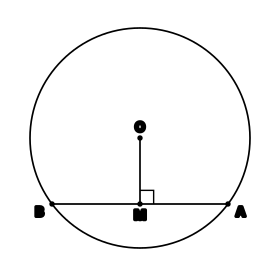
The perpendicular drawn from the centre of a circle to a chord:
Show answerHide answer
Answer: bisects the chord
Explanation: The perpendicular dropped from the centre to a chord always bisects that chord into two equal halves — a key circle theorem, not something that merely doubles or parallels the chord.
- Q3Medium
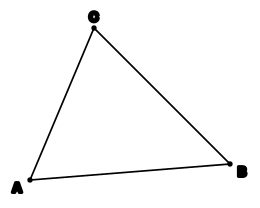
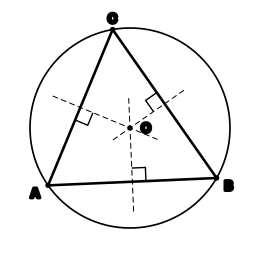
The centre of the unique circle through three non-collinear points is the point of intersection of the:
Show answerHide answer
Answer: perpendicular bisectors of the sides
Explanation: The centre must be equidistant from all three points, and the set of points equidistant from two of them is the perpendicular bisector of the segment joining them — so the centre lies at their intersection, not at the medians or altitudes.
- Q4Medium
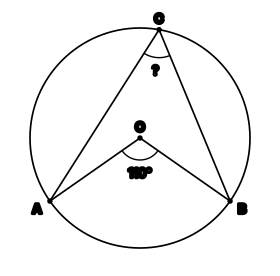
O is the centre of a circle and A, B are on it with ∠AOB = 110°. If C is a point on the major arc AB, then ∠ACB is:
Show answerHide answer
Answer: 55°
Explanation: The angle at the circumference is half the central angle: ∠ACB = 110° ÷ 2 = 55°. Using the full 110° would ignore the halving rule for a point on the major arc.
- Q5Hard
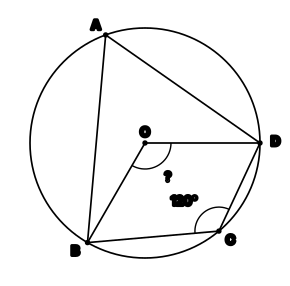
ABCD is a cyclic quadrilateral with centre O and ∠BCD = 120°. The central angle ∠BOD (on the side of C) is:
Show answerHide answer
Answer: 120°
Explanation: ∠BAD = 180° − 120° = 60° (opposite angle); central angle = 2 × inscribed angle, so ∠BOD = 2 × 60° = 120°, not 240° (doubling ∠BCD directly).
- Q6Hard
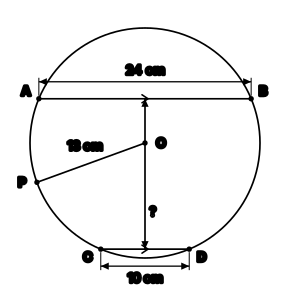
In a circle of radius 13 cm, two parallel chords of lengths 10 cm and 24 cm lie on opposite sides of the centre. The distance between them is:
Show answerHide answer
Answer: 17 cm
Explanation: The two chords sit √(13² − 5²) = 12 cm and √(13² − 12²) = 5 cm from the centre; since they are on opposite sides, the distance between them is the sum, 12 + 5 = 17 cm, not the difference 7 cm.
Key concepts: I'm Up and Down, and Round and Round (Class 9 Mathematics)
Everything in a circle follows from one fact: every point on it is the same distance from the centre. From that single property come the chord theorems, the relationship between the angle at the centre and the angle at the circumference, and the rule that opposite angles of a cyclic quadrilateral are supplementary.
- Circle
- The set of all points at a fixed distance (the radius) from a fixed point (the centre). Every theorem in the chapter is a consequence of this one definition.
- Chord
- A segment joining two points on the circle. The longest possible chord is the diameter, which passes through the centre.
- Arc, sector and segment
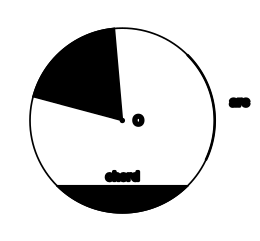
- An arc is a piece of the circle itself; a sector is the region between two radii and an arc; a segment is the region between a chord and its arc.
- Perpendicular from centre to a chord
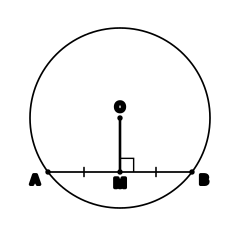
- The perpendicular dropped from the centre bisects the chord, and conversely the line from the centre to a chord's midpoint is perpendicular to it.
- Equal chords are equidistant
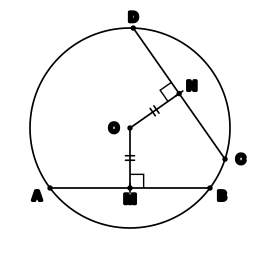
- Chords of equal length lie the same distance from the centre, and chords equidistant from the centre are equal. Longer chords sit closer to the centre.
- Angle subtended at the centre
- The angle a chord or arc makes at the centre. Equal chords subtend equal angles at the centre, and equal central angles cut off equal chords.
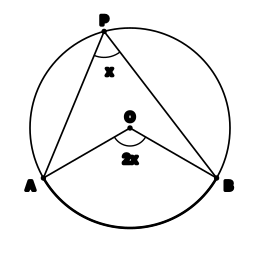
- Angle at centre is twice angle at circumference
- An arc subtends at the centre an angle exactly double the angle it subtends anywhere on the remaining part of the circle.
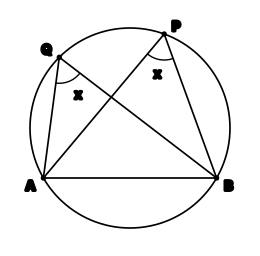
- Angles in the same segment
- All angles subtended by the same arc at points on the same side of it are equal, since each is half the same central angle.
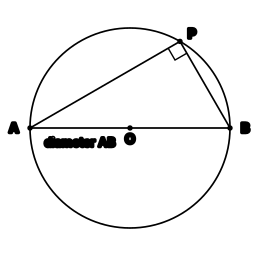
- Angle in a semicircle
- An angle subtended by a diameter at any point of the circle is a right angle — the central angle is 180°, so the inscribed angle is 90°.
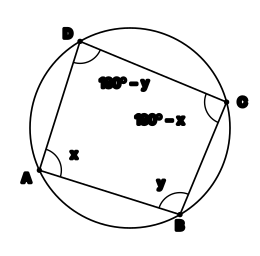
- Cyclic quadrilateral
- A quadrilateral with all four vertices on one circle. Its opposite angles are supplementary, adding to 180°.
- Converse for cyclic quadrilaterals
- If one pair of opposite angles of a quadrilateral adds to 180°, the four vertices must lie on a circle — the standard test for concyclic points.
- Exterior angle of a cyclic quadrilateral
- The exterior angle at any vertex equals the interior opposite angle, which follows directly from the supplementary-angles property.
- Concyclic points
- Points that all lie on one circle. Showing that a segment subtends equal angles at two points on the same side proves they are concyclic.
- Circumcentre
- The centre of the circle through all three vertices of a triangle, found where the perpendicular bisectors of the sides meet.
Start this chapter free
You have 6 to try above. Sign in with Google (no card needed). You get 1 Easy + 1 Medium quiz on every chapter, free for good — plus a free Hard quiz when you score 70%+ on a Medium quiz (1 per subject), and the formulas & exam tips.
This chapter has 90 questions (30 Easy · 30 Medium · 30 Hard), with timed scoring and instant feedback. The rest unlock with the ₹999/year plan.
Start this chapter free →I'm Up and Down, and Round and Round — FAQs
What are the key concepts in Class 9 Mathematics I'm Up and Down, and Round and Round?+
Everything in a circle follows from one fact: every point on it is the same distance from the centre. From that single property come the chord theorems, the relationship between the angle at the centre and the angle at the circumference, and the rule that opposite angles of a cyclic quadrilateral are supplementary. Key ideas include Circle, Chord, Arc, sector and segment, Perpendicular from centre to a chord, Equal chords are equidistant, Angle subtended at the centre.
What does Class 9 Mathematics Chapter 5 (I'm Up and Down, and Round and Round) cover on XamBaaz?+
It has 90 NCERT-based MCQs on "I'm Up and Down, and Round and Round": 30 Easy, 30 Medium and 30 Hard. Together they make 9 timed quizzes, and you never get the same set twice. Every question has an instant explanation. They help you prepare for CBSE Board exams and the JEE & NEET foundation years.
Are these "I'm Up and Down, and Round and Round" questions free to practise?+
Yes. Sign in with Google to practise "I'm Up and Down, and Round and Round" free. Full unlimited access is ₹999/year. One year from the day you pay. You stay in Class 9 till 31 March; on 1 April your account moves up to Class 10 and the rest of your year carries over. No chapter is charged separately.
How should I revise "I'm Up and Down, and Round and Round" for the exam?+
Start with the Easy quiz to check your basics, then try Medium and Hard to practise applying them. There are 9 timed quizzes on this chapter, so you can come back for a fresh set instead of one you have seen. Read each explanation, retry the questions you miss, and track your accuracy until it stays high.
Are these "I'm Up and Down, and Round and Round" MCQs available with answers?+
Yes. 6 sample questions are on this page with answers: tap an option, or "Show answer", to see the correct option and a step-by-step explanation. Sign in free with Google to start practising, with instant scoring.
Is there negative marking in the "I'm Up and Down, and Round and Round" quizzes?+
Yes. The timed quizzes use exam-style marking: +4 for a right answer, −1 for a wrong one and 0 for a skip. MHT-CET and CBSE board papers have no negative marking. Our mocks for those are scored their way.
What are the important questions from I'm Up and Down, and Round and Round (Class 9 Mathematics)?+
The questions that matter most test Circle, Chord, Arc, sector and segment, Perpendicular from centre to a chord, Equal chords are equidistant, Angle subtended at the centre. This page shows 6 solved important MCQs with answers and explanations. Sign in to practise all 90 questions on the chapter as timed quizzes.
Is there an online quiz for I'm Up and Down, and Round and Round?+
Yes — Class 9 Mathematics I'm Up and Down, and Round and Round has timed online quizzes at Easy, Medium and Hard levels, with instant scoring and a worked explanation on every question. The first quiz on the chapter is free.