
Reproduction: How Life Continues — Class 9 MCQs with Answers
Class 9 CBSE Science · Chapter 10
90 practice questions · 30 Easy · 30 Medium · 30 Hard · Updated
Practise the most important Class 9 CBSE Science questions from Chapter 10, "Reproduction: How Life Continues". You get 9 timed quizzes made from 90 NCERT-based MCQs, with answers and explanations. The questions are split into 30 Easy, 30 Medium and 30 Hard. Warm up on the basics, then move on to the exam-level questions that top scorers in CBSE Board exams and the JEE & NEET foundation years get right.
To score well in "Reproduction: How Life Continues", focus on clear concepts in physics, chemistry and biology basics. Each MCQ here is timed and uses exam-style marking (+4 correct, −1 wrong, 0 skipped). This helps you stay accurate when time is short, just as real papers need. Every question has a short explanation, so a wrong answer becomes a quick lesson. It is the fastest way to fix gaps before a test.
Use this chapter for focused revision. Start with the Easy set to check your basics on Reproduction: How Life Continues, then move to Medium and Hard to practise applying them. Your accuracy, streaks and XP save automatically. This chapter also adds to your overall Class 9 Science mastery score. Try the 6 sample questions below: tap an option to see the answer and a worked explanation. Sign in free to start practising.
Reproduction: How Life Continues — important questions & MCQs with answers (Class 9 Science)
6 solved questions from this chapter's difficulty levels, each with its answer and explanation. Tap an option to check yourself.
- Q1Easy
How many parents are involved in asexual reproduction?
Show answerHide answer
Answer: One
Explanation: Asexual reproduction needs only one parent and no gametes, unlike sexual reproduction where two parents contribute gametes that fuse.
- Q2Easy
Binary fission is the method of reproduction in:
Show answerHide answer
Answer: Amoeba
Explanation: Amoeba splits its single cell into two identical daughter cells by binary fission; Rhizopus instead forms spores and Hydra reproduces by budding.
- Q3Medium
A pollen grain carries the:
Show answerHide answer
Answer: Male gamete
Explanation: A pollen grain contains the plant's male gamete, which travels down a pollen tube to reach the egg cell inside the ovule; it is not itself a zygote or seed.
- Q4Medium
In humans, fertilisation normally takes place in the:
Show answerHide answer
Answer: Oviduct
Explanation: In humans, the sperm meets and fuses with the egg inside the oviduct (fallopian tube); the zygote only reaches the uterus afterward for implantation.
- Q5Hard
Which contraceptive method also protects against sexually transmitted diseases such as AIDS?
Show answerHide answer
Answer: Condoms
Explanation: Condoms form a physical barrier that blocks both sperm and disease-causing organisms, so they protect against pregnancy and STDs like AIDS; pills and IUDs prevent pregnancy only.
- Q6Hard
Why are offspring of asexual reproduction usually identical to the parent?
Show answerHide answer
Answer: Because only one parent is involved and no gametes fuse
Explanation: With only one parent contributing DNA and no gamete fusion to shuffle genes, asexual offspring are exact genetic copies of the parent, not because of shared food or habitat.
Key concepts: Reproduction: How Life Continues (Class 9 Science)
Reproduction is the process by which living organisms produce new individuals of their own kind, and it is essential for the continuity of a species rather than the survival of an individual. This chapter contrasts asexual and sexual reproduction, then works through reproduction in flowering plants and in humans.
- Reproduction
- The production of new individuals of the same species. Unlike nutrition or respiration it is not needed to keep an individual alive, but without it a species dies out.
- Asexual reproduction
- Reproduction involving a single parent and no gametes. The offspring are genetically identical to the parent, so they are clones.
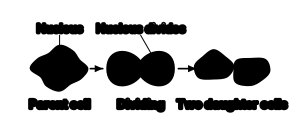
- Binary fission
- A single-celled organism such as Amoeba divides into two roughly equal daughter cells, each receiving a copy of the genetic material.
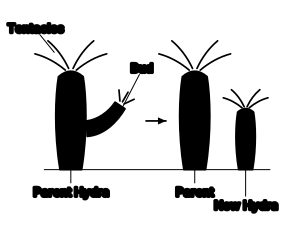
- Budding
- A small outgrowth on the parent grows, develops the parent's features and detaches, as in Hydra and yeast.
- Fragmentation and regeneration
- The body breaks into pieces and each piece grows into a complete organism, as in Spirogyra; regeneration is the related ability to rebuild lost body parts, as in Planaria.
- Vegetative propagation
- New plants arise from a vegetative part — root, stem or leaf — rather than from seed. It preserves the parent's characters exactly and is widely used in horticulture.
- Sexual reproduction
- Reproduction involving two parents and the fusion of male and female gametes, producing offspring with a new combination of characters.
- Gamete and fertilisation
- A gamete is a reproductive cell carrying half the genetic material; fertilisation is the fusion of a male and a female gamete to form a zygote.
- Zygote
- The single cell formed at fertilisation. It divides repeatedly to form the embryo and eventually the new individual.
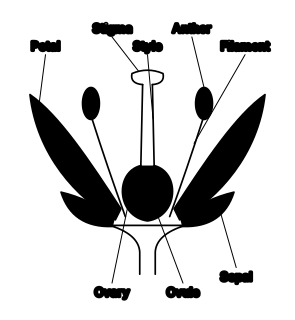
- Structure of a flower
- The four whorls are sepals, petals, stamens and carpel. Stamens and carpel are the essential (reproductive) whorls; sepals and petals are accessory.
- Stamen and carpel
- The stamen is the male part, made of anther and filament, producing pollen. The carpel is the female part, made of stigma, style and ovary, containing ovules.
- Pollination
- The transfer of pollen from anther to stigma. Self-pollination occurs within the same flower, cross-pollination between different flowers of the same species.
- Agents of pollination
- Pollen is carried by wind, water or animals such as insects and birds. Flower features like bright petals, scent and nectar are adaptations to attract animal pollinators.
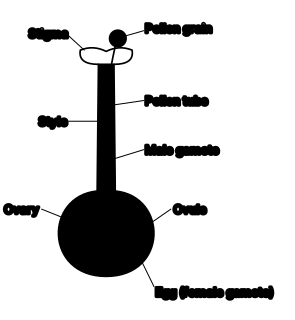
- Fertilisation in plants
- The pollen grain grows a tube down the style to the ovule, where the male gamete fuses with the egg. The ovule then becomes the seed and the ovary becomes the fruit.
- Human male reproductive system
- Testes produce sperm and the hormone testosterone; the sperm travel through the vas deferens and are released with secretions from associated glands.
- Human female reproductive system
- Ovaries produce eggs and female hormones; the egg travels along the oviduct, where fertilisation occurs, to the uterus in which the embryo develops.
- Placenta
- The tissue connecting the embryo to the mother's uterine wall, through which the embryo receives nutrients and oxygen and passes out waste.
- Reproductive health
- Complete physical and mental well-being in reproductive matters, including awareness of contraception and of sexually transmitted infections.
Start this chapter free
You have 6 to try above. Sign in with Google (no card needed). You get 1 Easy + 1 Medium quiz on every chapter, free for good — plus a free Hard quiz when you score 70%+ on a Medium quiz (1 per subject), and the exam tips.
This chapter has 90 questions (30 Easy · 30 Medium · 30 Hard), with timed scoring and instant feedback. The rest unlock with the ₹999/year plan.
Start this chapter free →Reproduction: How Life Continues — FAQs
What are the key concepts in Class 9 Science Reproduction: How Life Continues?+
Reproduction is the process by which living organisms produce new individuals of their own kind, and it is essential for the continuity of a species rather than the survival of an individual. This chapter contrasts asexual and sexual reproduction, then works through reproduction in flowering plants and in humans. Key ideas include Reproduction, Asexual reproduction, Binary fission, Budding, Fragmentation and regeneration, Vegetative propagation.
What does Class 9 Science Chapter 10 (Reproduction: How Life Continues) cover on XamBaaz?+
It has 90 NCERT-based MCQs on "Reproduction: How Life Continues": 30 Easy, 30 Medium and 30 Hard. Together they make 9 timed quizzes, and you never get the same set twice. Every question has an instant explanation. They help you prepare for CBSE Board exams and the JEE & NEET foundation years.
Are these "Reproduction: How Life Continues" questions free to practise?+
Yes. Sign in with Google to practise "Reproduction: How Life Continues" free. Full unlimited access is ₹999/year. One year from the day you pay. You stay in Class 9 till 31 March; on 1 April your account moves up to Class 10 and the rest of your year carries over. No chapter is charged separately.
How should I revise "Reproduction: How Life Continues" for the exam?+
Start with the Easy quiz to check your basics, then try Medium and Hard to practise applying them. There are 9 timed quizzes on this chapter, so you can come back for a fresh set instead of one you have seen. Read each explanation, retry the questions you miss, and track your accuracy until it stays high.
Are these "Reproduction: How Life Continues" MCQs available with answers?+
Yes. 6 sample questions are on this page with answers: tap an option, or "Show answer", to see the correct option and a step-by-step explanation. Sign in free with Google to start practising, with instant scoring.
Is there negative marking in the "Reproduction: How Life Continues" quizzes?+
Yes. The timed quizzes use exam-style marking: +4 for a right answer, −1 for a wrong one and 0 for a skip. MHT-CET and CBSE board papers have no negative marking. Our mocks for those are scored their way.
What are the important questions from Reproduction: How Life Continues (Class 9 Science)?+
The questions that matter most test Reproduction, Asexual reproduction, Binary fission, Budding, Fragmentation and regeneration, Vegetative propagation. This page shows 6 solved important MCQs with answers and explanations. Sign in to practise all 90 questions on the chapter as timed quizzes.
Is there an online quiz for Reproduction: How Life Continues?+
Yes — Class 9 Science Reproduction: How Life Continues has timed online quizzes at Easy, Medium and Hard levels, with instant scoring and a worked explanation on every question. The first quiz on the chapter is free.