
Patterns in Life: Diversity and Classification — Class 9 MCQs with Answers
Class 9 CBSE Science · Chapter 11
90 practice questions · 30 Easy · 30 Medium · 30 Hard · Updated
Practise the most important Class 9 CBSE Science questions from Chapter 11, "Patterns in Life: Diversity and Classification". You get 9 timed quizzes made from 90 NCERT-based MCQs, with answers and explanations. The questions are split into 30 Easy, 30 Medium and 30 Hard. Warm up on the basics, then move on to the exam-level questions that top scorers in CBSE Board exams and the JEE & NEET foundation years get right.
To score well in "Patterns in Life: Diversity and Classification", focus on clear concepts in physics, chemistry and biology basics. Each MCQ here is timed and uses exam-style marking (+4 correct, −1 wrong, 0 skipped). This helps you stay accurate when time is short, just as real papers need. Every question has a short explanation, so a wrong answer becomes a quick lesson. It is the fastest way to fix gaps before a test.
Use this chapter for focused revision. Start with the Easy set to check your basics on Patterns in Life: Diversity and Classification, then move to Medium and Hard to practise applying them. Your accuracy, streaks and XP save automatically. This chapter also adds to your overall Class 9 Science mastery score. Try the 6 sample questions below: tap an option to see the answer and a worked explanation. Sign in free to start practising.
Patterns in Life: Diversity and Classification — important questions & MCQs with answers (Class 9 Science)
6 solved questions from this chapter's difficulty levels, each with its answer and explanation. Tap an option to check yourself.
- Q1Easy
Who proposed the five-kingdom classification of living organisms?
Show answerHide answer
Answer: R. H. Whittaker
Explanation: R. H. Whittaker proposed the five-kingdom system in 1969, based on cell structure and nutrition — Linnaeus is remembered for naming species, not for this classification.
- Q2Easy
The system of giving each organism a two-part scientific name is called:
Show answerHide answer
Answer: Binomial nomenclature
Explanation: Giving each species a two-part genus-plus-species name is called binomial nomenclature, distinct from classification (grouping) or identification (recognising).
- Q3Medium
A virus is made up of a protein coat and:
Show answerHide answer
Answer: Genetic material
Explanation: A virus is simply nucleic acid (DNA or RNA) wrapped in a protein coat — it has no organelles, nucleus or cell wall of its own.
- Q4Medium
Which of the following is a basis for classifying organisms into the five kingdoms?
Show answerHide answer
Answer: Cell structure and mode of nutrition
Explanation: The five kingdoms are defined by cell structure (prokaryotic vs eukaryotic) and mode of nutrition, not by habitat, colour or size alone.
- Q5Hard
Bryophytes are called the 'amphibians of the plant kingdom' because they:
Show answerHide answer
Answer: Live on land but require water for reproduction
Explanation: Bryophytes live on land like true land plants, but their sperm must swim through a film of water to reach the egg, echoing an amphibian's dependence on water for reproduction.
- Q6Hard
What is the key difference between kingdoms Monera and Protista?
Show answerHide answer
Answer: Monera are prokaryotic while Protista are eukaryotic
Explanation: Monera are prokaryotes, lacking a membrane-bound nucleus, while Protista are eukaryotes with a true nucleus — that cell-structure difference is the key distinction.
Key concepts: Patterns in Life: Diversity and Classification (Class 9 Science)
Millions of species exist, so biologists group them by shared characteristics rather than studying each separately. This chapter builds the classification hierarchy, works through the five kingdoms and the major plant and animal divisions, and explains binomial nomenclature and the peculiar position of viruses.
- Classification
- Arranging organisms into groups based on shared characteristics. It makes the study of enormous diversity manageable and reveals evolutionary relationships.
- Basis of classification
- Groups are formed on fundamental characteristics — cell type, number of cells, mode of nutrition and body organisation — rather than superficial resemblance.
- Taxonomic hierarchy
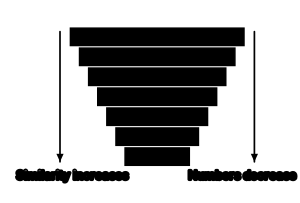
- The ranked series Kingdom, Phylum (or Division), Class, Order, Family, Genus, Species. Moving down the ranks, similarity increases and numbers decrease.
- Species
- The basic unit of classification: a group of organisms so similar that they can interbreed and produce fertile offspring.
- Binomial nomenclature
- Carolus Linnaeus's two-word naming system: genus followed by species, as in Homo sapiens. It gives every organism one universally accepted name.
- Rules of writing scientific names
- The genus begins with a capital letter and the species with a small one; the name is italicised in print and underlined separately when handwritten.
- Five-kingdom classification
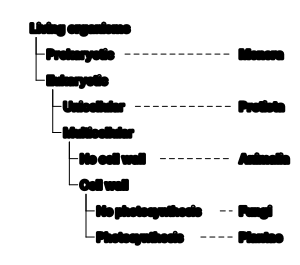
- Whittaker's scheme of Monera, Protista, Fungi, Plantae and Animalia, based on cell structure, body organisation and mode of nutrition.
- Monera
- Prokaryotes — organisms without a true nucleus or membrane-bound organelles, such as bacteria and blue-green algae. They may be autotrophic or heterotrophic.
- Protista
- Unicellular eukaryotes such as Amoeba, Paramecium and Euglena, often moving by cilia, flagella or pseudopodia.
- Fungi
- Eukaryotic, mostly multicellular heterotrophs that feed saprophytically on dead organic matter and have cell walls of chitin.
- Plant divisions
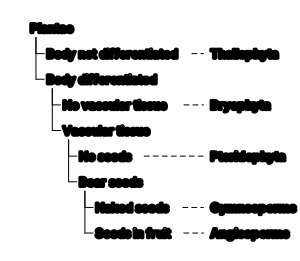
- Plantae is divided into Thallophyta, Bryophyta, Pteridophyta, Gymnosperms and Angiosperms, in order of increasing complexity of body and reproductive structure.
- Bryophyta — the amphibians of the plant kingdom
- Plants such as mosses that live on land but need water for the transfer of male gametes during reproduction, hence the nickname.
- Angiosperms and gymnosperms
- Angiosperms bear seeds enclosed inside a fruit, while gymnosperms bear naked seeds. Angiosperms are further split into monocots and dicots by seed leaf number.
- Animal phyla
- The major groups run Porifera, Coelenterata, Platyhelminthes, Nematoda, Annelida, Arthropoda, Mollusca, Echinodermata and Chordata, in broadly increasing complexity.
- Arthropoda
- The largest animal phylum, with jointed legs, an exoskeleton of chitin and an open circulatory system — insects, spiders and crustaceans.
- Chordata
- Animals with a notochord, a dorsal hollow nerve cord and paired gill pouches at some stage of life. Vertebrates are the familiar sub-group.
- Vertebrate classes
- Pisces, Amphibia, Reptilia, Aves and Mammalia, distinguished by features such as skin covering, respiratory organs, body temperature control and mode of reproduction.
- Viruses
- Non-cellular entities of nucleic acid within a protein coat. They are inert outside a host and reproduce only inside a living cell, so they sit outside the five-kingdom scheme.
Start this chapter free
You have 6 to try above. Sign in with Google (no card needed). You get 1 Easy + 1 Medium quiz on every chapter, free for good — plus a free Hard quiz when you score 70%+ on a Medium quiz (1 per subject), and the exam tips.
This chapter has 90 questions (30 Easy · 30 Medium · 30 Hard), with timed scoring and instant feedback. The rest unlock with the ₹999/year plan.
Start this chapter free →Patterns in Life: Diversity and Classification — FAQs
What are the key concepts in Class 9 Science Patterns in Life: Diversity and Classification?+
Millions of species exist, so biologists group them by shared characteristics rather than studying each separately. This chapter builds the classification hierarchy, works through the five kingdoms and the major plant and animal divisions, and explains binomial nomenclature and the peculiar position of viruses. Key ideas include Classification, Basis of classification, Taxonomic hierarchy, Species, Binomial nomenclature, Rules of writing scientific names.
What does Class 9 Science Chapter 11 (Patterns in Life: Diversity and Classification) cover on XamBaaz?+
It has 90 NCERT-based MCQs on "Patterns in Life: Diversity and Classification": 30 Easy, 30 Medium and 30 Hard. Together they make 9 timed quizzes, and you never get the same set twice. Every question has an instant explanation. They help you prepare for CBSE Board exams and the JEE & NEET foundation years.
Are these "Patterns in Life: Diversity and Classification" questions free to practise?+
Yes. Sign in with Google to practise "Patterns in Life: Diversity and Classification" free. Full unlimited access is ₹999/year. One year from the day you pay. You stay in Class 9 till 31 March; on 1 April your account moves up to Class 10 and the rest of your year carries over. No chapter is charged separately.
How should I revise "Patterns in Life: Diversity and Classification" for the exam?+
Start with the Easy quiz to check your basics, then try Medium and Hard to practise applying them. There are 9 timed quizzes on this chapter, so you can come back for a fresh set instead of one you have seen. Read each explanation, retry the questions you miss, and track your accuracy until it stays high.
Are these "Patterns in Life: Diversity and Classification" MCQs available with answers?+
Yes. 6 sample questions are on this page with answers: tap an option, or "Show answer", to see the correct option and a step-by-step explanation. Sign in free with Google to start practising, with instant scoring.
Is there negative marking in the "Patterns in Life: Diversity and Classification" quizzes?+
Yes. The timed quizzes use exam-style marking: +4 for a right answer, −1 for a wrong one and 0 for a skip. MHT-CET and CBSE board papers have no negative marking. Our mocks for those are scored their way.
What are the important questions from Patterns in Life: Diversity and Classification (Class 9 Science)?+
The questions that matter most test Classification, Basis of classification, Taxonomic hierarchy, Species, Binomial nomenclature, Rules of writing scientific names. This page shows 6 solved important MCQs with answers and explanations. Sign in to practise all 90 questions on the chapter as timed quizzes.
Is there an online quiz for Patterns in Life: Diversity and Classification?+
Yes — Class 9 Science Patterns in Life: Diversity and Classification has timed online quizzes at Easy, Medium and Hard levels, with instant scoring and a worked explanation on every question. The first quiz on the chapter is free.