
Earth as a System: Energy, Matter, and Life — Class 9 MCQs with Answers
Class 9 CBSE Science · Chapter 12
90 practice questions · 30 Easy · 30 Medium · 30 Hard · Updated
Practise the most important Class 9 CBSE Science questions from Chapter 12, "Earth as a System: Energy, Matter, and Life". You get 9 timed quizzes made from 90 NCERT-based MCQs, with answers and explanations. The questions are split into 30 Easy, 30 Medium and 30 Hard. Warm up on the basics, then move on to the exam-level questions that top scorers in CBSE Board exams and the JEE & NEET foundation years get right.
To score well in "Earth as a System: Energy, Matter, and Life", focus on clear concepts in physics, chemistry and biology basics. Each MCQ here is timed and uses exam-style marking (+4 correct, −1 wrong, 0 skipped). This helps you stay accurate when time is short, just as real papers need. Every question has a short explanation, so a wrong answer becomes a quick lesson. It is the fastest way to fix gaps before a test.
Use this chapter for focused revision. Start with the Easy set to check your basics on Earth as a System: Energy, Matter, and Life, then move to Medium and Hard to practise applying them. Your accuracy, streaks and XP save automatically. This chapter also adds to your overall Class 9 Science mastery score. Try the 6 sample questions below: tap an option to see the answer and a worked explanation. Sign in free to start practising.
Earth as a System: Energy, Matter, and Life — important questions & MCQs with answers (Class 9 Science)
6 solved questions from this chapter's difficulty levels, each with its answer and explanation. Tap an option to check yourself.
- Q1Easy
The primary source of energy for almost all processes on the Earth is the:
Show answerHide answer
Answer: Sun
Explanation: The Sun powers nearly every Earth process — weather, the water cycle, photosynthesis — by radiating energy across space; wind and ocean currents only redistribute heat the Sun already supplied.
- Q2Easy
All the water on the Earth — oceans, rivers, lakes and groundwater — makes up the:
Show answerHide answer
Answer: Hydrosphere
Explanation: The hydrosphere is the Earth's water sphere — oceans, rivers, lakes and groundwater together — distinct from the biosphere (living things), geosphere (rock and soil) and atmosphere (gases).
- Q3Medium
Nitrogen-fixing bacteria are important because they convert atmospheric nitrogen into:
Show answerHide answer
Answer: Nitrogen compounds
Explanation: Nitrogen-fixing bacteria convert inert atmospheric N₂ into nitrogen compounds like ammonia and nitrates that plants can actually absorb and use to build proteins.
- Q4Medium
The equator receives more heat than the poles because there the Sun's rays fall:
Show answerHide answer
Answer: More directly
Explanation: The equator receives more heat because sunlight strikes it almost vertically, concentrating energy on a small area, while polar rays hit at a slant and spread out over a wider one.
- Q5Hard
How does the greenhouse effect warm the Earth?
Show answerHide answer
Answer: Greenhouse gases trap infrared radiation given off by the Earth
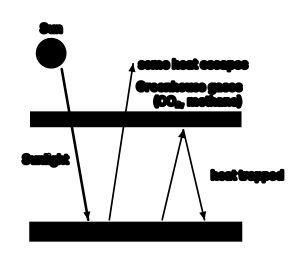
Explanation: Greenhouse gases like CO₂ let incoming sunlight through but absorb and re-emit the infrared heat Earth radiates back out, trapping warmth near the surface rather than blocking sunlight.
- Q6Hard
Which arrangement of the electromagnetic spectrum is correct, from longest to shortest wavelength?
Show answerHide answer
Answer: Radio waves → infrared → visible → ultraviolet → X-rays
Explanation: From longest to shortest wavelength, the electromagnetic spectrum runs radio waves, infrared, visible light, ultraviolet, then X-rays — wavelength shrinks and frequency rises along this order.
Key concepts: Earth as a System: Energy, Matter, and Life (Class 9 Science)
The Earth works as a single system of interacting spheres — geosphere, hydrosphere, atmosphere, cryosphere and biosphere — driven by energy from the Sun. Uneven heating drives winds and currents, matter is recycled through biogeochemical cycles, and human activity is now altering both.
- Earth as a system
- The Earth's components are not independent: a change in one sphere produces changes in the others, so the planet behaves as a single interacting system.
- Geosphere
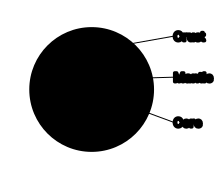
- The solid Earth — crust, mantle and core — which supplies mineral nutrients and forms the land surface on which life depends.
- Hydrosphere
- All the water on Earth: oceans, rivers, lakes and groundwater. Water's high heat capacity makes it a powerful moderator of temperature.
- Atmosphere
- The envelope of gases around the Earth, roughly 78% nitrogen and 21% oxygen, which shields life from harmful radiation and holds in heat.
- Cryosphere
- The frozen part of the Earth — glaciers, ice sheets, sea ice and snow. Its bright surface reflects a large share of incoming sunlight.
- Biosphere
- The zone occupied by living organisms, overlapping the other spheres and exchanging gases, water and nutrients with all of them.
- Solar energy as the driver
- Almost all processes at the Earth's surface are powered by sunlight, which drives the water cycle, winds, ocean currents and photosynthesis.
- Albedo
- The fraction of incoming sunlight a surface reflects. Ice and snow have high albedo and cool the planet; dark oceans and forests absorb more and warm it.
- Differential heating
- The Sun heats the Earth unevenly — most strongly at the equator and least at the poles, and land faster than water. These differences set air and water in motion.
- Convection
- Warm air or water expands, becomes less dense and rises while cooler material sinks to replace it, setting up a circulating current that transports heat.
- Land and sea breeze
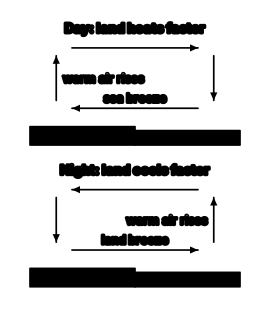
- Land heats and cools faster than the sea, so air flows from sea to land by day and from land to sea by night — differential heating on a local scale.
- Water cycle
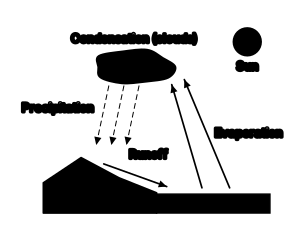
- The continuous movement of water through evaporation, condensation, precipitation and runoff, redistributing both water and heat around the planet.
- Biogeochemical cycle
- The circulation of an element between living organisms and the non-living environment, so that a finite stock of matter is used repeatedly.
- Carbon cycle
- Carbon moves between atmosphere, oceans, rocks and living things through photosynthesis, respiration, decomposition and combustion of fuels.
- Nitrogen cycle
- Atmospheric nitrogen is fixed into usable compounds by bacteria and lightning, passes through organisms, and is returned to the air by denitrification.
- Decomposers
- Bacteria and fungi that break down dead matter, releasing nutrients back into the soil and air. Without them the cycles would stall.
- Greenhouse effect
- Gases such as carbon dioxide and methane trap outgoing heat and keep the Earth warm enough for life; raising their concentration intensifies the warming.
- Human impact
- Deforestation, burning fossil fuels and pollution alter the composition of the atmosphere and disturb the natural cycles faster than they can rebalance.
Start this chapter free
You have 6 to try above. Sign in with Google (no card needed). You get 1 Easy + 1 Medium quiz on every chapter, free for good — plus a free Hard quiz when you score 70%+ on a Medium quiz (1 per subject), and the exam tips.
This chapter has 90 questions (30 Easy · 30 Medium · 30 Hard), with timed scoring and instant feedback. The rest unlock with the ₹999/year plan.
Start this chapter free →Earth as a System: Energy, Matter, and Life — FAQs
What are the key concepts in Class 9 Science Earth as a System: Energy, Matter, and Life?+
The Earth works as a single system of interacting spheres — geosphere, hydrosphere, atmosphere, cryosphere and biosphere — driven by energy from the Sun. Uneven heating drives winds and currents, matter is recycled through biogeochemical cycles, and human activity is now altering both. Key ideas include Earth as a system, Geosphere, Hydrosphere, Atmosphere, Cryosphere, Biosphere.
What does Class 9 Science Chapter 12 (Earth as a System: Energy, Matter, and Life) cover on XamBaaz?+
It has 90 NCERT-based MCQs on "Earth as a System: Energy, Matter, and Life": 30 Easy, 30 Medium and 30 Hard. Together they make 9 timed quizzes, and you never get the same set twice. Every question has an instant explanation. They help you prepare for CBSE Board exams and the JEE & NEET foundation years.
Are these "Earth as a System: Energy, Matter, and Life" questions free to practise?+
Yes. Sign in with Google to practise "Earth as a System: Energy, Matter, and Life" free. Full unlimited access is ₹999/year. One year from the day you pay. You stay in Class 9 till 31 March; on 1 April your account moves up to Class 10 and the rest of your year carries over. No chapter is charged separately.
How should I revise "Earth as a System: Energy, Matter, and Life" for the exam?+
Start with the Easy quiz to check your basics, then try Medium and Hard to practise applying them. There are 9 timed quizzes on this chapter, so you can come back for a fresh set instead of one you have seen. Read each explanation, retry the questions you miss, and track your accuracy until it stays high.
Are these "Earth as a System: Energy, Matter, and Life" MCQs available with answers?+
Yes. 6 sample questions are on this page with answers: tap an option, or "Show answer", to see the correct option and a step-by-step explanation. Sign in free with Google to start practising, with instant scoring.
Is there negative marking in the "Earth as a System: Energy, Matter, and Life" quizzes?+
Yes. The timed quizzes use exam-style marking: +4 for a right answer, −1 for a wrong one and 0 for a skip. MHT-CET and CBSE board papers have no negative marking. Our mocks for those are scored their way.
What are the important questions from Earth as a System: Energy, Matter, and Life (Class 9 Science)?+
The questions that matter most test Earth as a system, Geosphere, Hydrosphere, Atmosphere, Cryosphere, Biosphere. This page shows 6 solved important MCQs with answers and explanations. Sign in to practise all 90 questions on the chapter as timed quizzes.
Is there an online quiz for Earth as a System: Energy, Matter, and Life?+
Yes — Class 9 Science Earth as a System: Energy, Matter, and Life has timed online quizzes at Easy, Medium and Hard levels, with instant scoring and a worked explanation on every question. The first quiz on the chapter is free.