
Quadratic Equations — Class 10 MCQs with Answers
Class 10 CBSE Mathematics · Chapter 4
108 practice questions · 31 Easy · 39 Medium · 38 Hard · Updated
Jump to the 6 solved questions
Practise the most important Class 10 CBSE Mathematics questions from Chapter 4, "Quadratic Equations". You get 11 timed quizzes made from 108 NCERT-based MCQs, with answers and explanations. The questions are split into 31 Easy, 39 Medium and 38 Hard. Warm up on the basics, then move on to the exam-level questions that top scorers in CBSE Board exams and the JEE & NEET foundation years get right.
To score well in "Quadratic Equations", focus on fast problem-solving, formula recall and step-by-step working. Each MCQ here is timed and uses exam-style marking (+4 correct, −1 wrong, 0 skipped). This helps you stay accurate when time is short, just as real papers need. Every question has a short explanation, so a wrong answer becomes a quick lesson. It is the fastest way to fix gaps before a test.
Use this chapter for focused revision. Start with the Easy set to check your basics on Quadratic Equations, then move to Medium and Hard to practise applying them. Your accuracy, streaks and XP save automatically. This chapter also adds to your overall Class 10 Mathematics mastery score. Try the 6 sample questions below: tap an option to see the answer and a worked explanation. Sign in free to start practising.
Quadratic Equations — important questions & MCQs with answers (Class 10 Mathematics)
6 solved questions from this chapter's difficulty levels, each with its answer and explanation. Tap an option to check yourself.
0 of 6 answered
- Q1 of 6Easy
Which of the following is a quadratic equation?
Show answerHide answer
Answer: x² + 2x − 3 = 0
Explanation: A quadratic equation has degree exactly 2, form ax² + bx + c = 0 with a ≠ 0; 2x − 5 = 0 is linear, x³ − 1 = 0 cubic, x⁴ + 2 = 0 quartic — only x² + 2x − 3 = 0 fits the degree-2 pattern.
- Q2 of 6Easy
The roots of x² − 5x + 6 = 0 are:
Show answerHide answer
Answer: 2, 3
Explanation: Factorise: x² − 5x + 6 = (x − 2)(x − 3) = 0, giving roots 2 and 3 — check: sum 5 matches −b/a and product 6 matches c/a.
- Q3 of 6Medium
The nature of roots of 2x² − 3x + 5 = 0 is:
Show answerHide answer
Answer: Not real
Explanation: D = b² − 4ac = (−3)² − 4(2)(5) = 9 − 40 = −31, which is negative, so the roots are not real.
- Q4 of 6Medium
Assertion (A): The roots of the equation 9x² – 6x + 1 = 0 are equal. Reason (R): A quadratic equation has two equal real roots if b² – 4ac > 0.
Show answerHide answer
Answer: A is true but R is false
Explanation: A is true: b² – 4ac = 36 – 36 = 0, so the roots are equal. R is false: equal roots need b² – 4ac = 0, while b² – 4ac > 0 gives two distinct real roots.
- Q5 of 6Hard
The quadratic equation 2x² + kx + 2 = 0 has equal roots when k equals:
Show answerHide answer
Answer: ±4
Explanation: Equal roots need D = 0: k² − 4(2)(2) = k² − 16 = 0, so k = ±4.
- Q6 of 6Hard
Assertion (A): The two consecutive positive integers whose product is 272 are 16 and 17. Reason (R): A quadratic equation ax² + bx + c = 0 has no real roots if b² – 4ac < 0.
Show answerHide answer
Answer: Both A and R are true but R is not the correct explanation of A
Explanation: A is true: n(n + 1) = 272 gives n² + n – 272 = 0, so (n – 16)(n + 17) = 0 and n = 16. R is also true, but this equation has b² – 4ac = 1089 > 0, so R does not explain A.
Quadratic Equations notes: key concepts (Class 10 Mathematics)
A quadratic equation can have two, one or no real roots, and the discriminant decides which without solving. This chapter solves quadratics by factorisation, by completing the square and by the quadratic formula, and applies them to word problems.
- Quadratic equation
- An equation of the form ax² + bx + c = 0 with a ≠ 0. The condition a ≠ 0 is what keeps it quadratic rather than linear.
- Standard form
- Every quadratic must be rearranged to ax² + bx + c = 0 before any method is applied, with all terms on one side.
- Root of a quadratic
- A value of x satisfying the equation; geometrically it is where the parabola meets the x-axis.
- Solving by factorisation
- Split the middle term into two parts whose product is ac and whose sum is b, factor in pairs, then set each factor to zero.
- Zero-product rule
- If a product of two factors is zero then at least one factor is zero — the principle that makes factorisation work.
- Completing the square
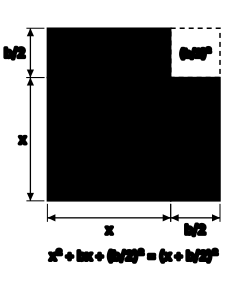
- Rewriting ax² + bx + c as a perfect square plus a constant, which solves the equation and also derives the quadratic formula.
- Quadratic formula
- A direct expression for both roots in terms of a, b and c, usable on any quadratic including those that will not factorise.
- Discriminant
- The quantity D = b² − 4ac, whose sign alone reveals the nature of the roots before any solving is done.
- Nature of roots
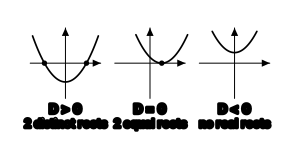
- D > 0 gives two distinct real roots, D = 0 gives two equal real roots, and D < 0 gives no real roots at all.
- Relation between roots and coefficients
- The roots add to −b/a and multiply to c/a, providing a fast check on any answer.
- Word problems
- Situations involving areas, speeds, ages and numbers that produce a quadratic; reject any root that is physically impossible, such as a negative length.
Start this chapter free
You have 6 to try above. Sign in with Google (no card needed). You get 1 Easy + 1 Medium quiz on every chapter, free for good (up to 6 quizzes a day) — plus a free Hard quiz when you score 70%+ on a Medium quiz (1 per subject), and the formulas & exam tips.
This chapter has 108 questions (31 Easy · 39 Medium · 38 Hard), with timed scoring and instant feedback. The rest unlock with the ₹999/year plan.
Start with the questions above. The full quiz opens here after.
Quadratic Equations — FAQs
What are the key concepts in Class 10 Mathematics Quadratic Equations?+
A quadratic equation can have two, one or no real roots, and the discriminant decides which without solving. This chapter solves quadratics by factorisation, by completing the square and by the quadratic formula, and applies them to word problems. Key ideas include Quadratic equation, Standard form, Root of a quadratic, Solving by factorisation, Zero-product rule, Completing the square.
What does Class 10 Mathematics Chapter 4 (Quadratic Equations) cover on XamBaaz?+
It has 108 NCERT-based MCQs on "Quadratic Equations": 31 Easy, 39 Medium and 38 Hard. Together they make 11 timed quizzes, and you never get the same set twice. Every question has an instant explanation. They help you prepare for CBSE Board exams and the JEE & NEET foundation years.
Are these "Quadratic Equations" questions free to practise?+
Yes. Sign in with Google to practise "Quadratic Equations" free. Full unlimited access is ₹999/year. One year from the day you pay. You stay in Class 10 till 31 March; on 1 April your account moves up to Class 11 and the rest of your year carries over. No chapter is charged separately.
How should I revise "Quadratic Equations" for the exam?+
Start with the Easy quiz to check your basics, then try Medium and Hard to practise applying them. There are 11 timed quizzes on this chapter, so you can come back for a fresh set instead of one you have seen. Read each explanation, retry the questions you miss, and track your accuracy until it stays high.
Are these "Quadratic Equations" MCQs available with answers?+
Yes. 6 sample questions are on this page with answers: tap an option, or "Show answer", to see the correct option and a step-by-step explanation. Sign in free with Google to start practising, with instant scoring.
Is there negative marking in the "Quadratic Equations" quizzes?+
Yes. The timed quizzes use exam-style marking: +4 for a right answer, −1 for a wrong one and 0 for a skip. MHT-CET and CBSE board papers have no negative marking. Our mocks for those are scored their way.
What are the important questions from Quadratic Equations (Class 10 Mathematics)?+
The questions that matter most test Quadratic equation, Standard form, Root of a quadratic, Solving by factorisation, Zero-product rule, Completing the square. This page shows 6 solved important MCQs with answers and explanations. Sign in to practise all 108 questions on the chapter as timed quizzes.
Is there an online quiz for Quadratic Equations?+
Yes — Class 10 Mathematics Quadratic Equations has timed online quizzes at Easy, Medium and Hard levels, with instant scoring and a worked explanation on every question. The first quiz on the chapter is free.
Are there question answers and extra questions for Quadratic Equations (Class 10 Mathematics)?+
Yes. This page has 6 solved questions on Quadratic Equations, each with the correct answer and a short explanation. Sign in to practise all 108 questions on the chapter as timed quizzes.
Are there assertion–reason and case study questions for Quadratic Equations (Class 10 Mathematics)?+
Yes. The Quadratic Equations question bank has 6 assertion–reason questions and 12 case-based (case study) questions in the CBSE board format, alongside the regular MCQs. Each comes with the answer and a worked explanation. Sign in to practise them in timed quizzes.