
Polynomials — Class 10 MCQs with Answers
Class 10 CBSE Mathematics · Chapter 2
108 practice questions · 31 Easy · 39 Medium · 38 Hard · Updated
Jump to the 6 solved questions
Practise the most important Class 10 CBSE Mathematics questions from Chapter 2, "Polynomials". You get 11 timed quizzes made from 108 NCERT-based MCQs, with answers and explanations. The questions are split into 31 Easy, 39 Medium and 38 Hard. Warm up on the basics, then move on to the exam-level questions that top scorers in CBSE Board exams and the JEE & NEET foundation years get right.
To score well in "Polynomials", focus on fast problem-solving, formula recall and step-by-step working. Each MCQ here is timed and uses exam-style marking (+4 correct, −1 wrong, 0 skipped). This helps you stay accurate when time is short, just as real papers need. Every question has a short explanation, so a wrong answer becomes a quick lesson. It is the fastest way to fix gaps before a test.
Use this chapter for focused revision. Start with the Easy set to check your basics on Polynomials, then move to Medium and Hard to practise applying them. Your accuracy, streaks and XP save automatically. This chapter also adds to your overall Class 10 Mathematics mastery score. Try the 6 sample questions below: tap an option to see the answer and a worked explanation. Sign in free to start practising.
Polynomials — important questions & MCQs with answers (Class 10 Mathematics)
6 solved questions from this chapter's difficulty levels, each with its answer and explanation. Tap an option to check yourself.
0 of 6 answered
- Q1 of 6Easy
The degree of the polynomial p(x) = 4x³ − 2x² + 7x − 5 is:
Show answerHide answer
Answer: 3
Explanation: Degree = highest power of x with a nonzero coefficient. In 4x³ − 2x² + 7x − 5 that's x³, so the degree is 3, not the number of terms (4).
- Q2 of 6Easy
The degree of the polynomial 4x³ − 2x² + 5x − 7 is:
Show answerHide answer
Answer: 3
Explanation: Degree is the highest exponent of x with a nonzero coefficient. In 4x³ − 2x² + 5x − 7 the leading term is 4x³, giving degree 3.
- Q3 of 6Medium
If one zero of x² − 5x + k is 2, then k equals:
Show answerHide answer
Answer: 6
Explanation: Substitute the known zero into the polynomial: p(2) = 2² − 5(2) + k = 4 − 10 + k = 0, so k = 6.
- Q4 of 6Medium
Assertion (A): The quadratic polynomial x² – 5x + 6 has no zeroes. Reason (R): The zeroes of a polynomial p(x) are the x-coordinates of the points where the graph of y = p(x) intersects the x-axis.
Show answerHide answer
Answer: A is false but R is true
Explanation: R is true. A is false: x² – 5x + 6 = (x – 2)(x – 3), so 2 and 3 are its zeroes, and its graph cuts the x-axis at x = 2 and x = 3.
- Q5 of 6Hard
If α and β are zeroes of x² − 5x + 6, then α² + β² =
Show answerHide answer
Answer: 13
Explanation: α + β = −(−5)/1 = 5 and αβ = 6/1 = 6. Using α² + β² = (α+β)² − 2αβ = 25 − 12 = 13; forgetting to subtract 2αβ gives the tempting 25 instead.
- Q6 of 6Hard
Assertion (A): The zeroes of 4x² – 4x – 3 are 3/2 and –1/2. Reason (R): The graph of y = ax² + bx + c opens upwards when a > 0.
Show answerHide answer
Answer: Both A and R are true but R is not the correct explanation of A
Explanation: A is true: 4x² – 4x – 3 = (2x – 3)(2x + 1), which is 0 at x = 3/2 and x = –1/2. R is also true, but the shape of the graph does not tell us these zeroes.
Polynomials notes: key concepts (Class 10 Mathematics)
A polynomial's zeroes are where its graph meets the x-axis, and they are tied to its coefficients by fixed relationships. This chapter reads zeroes off a graph, links them to the coefficients for quadratics and cubics, and divides one polynomial by another.
- Polynomial and its degree
- An expression in whole-number powers of a variable; the degree is the highest power present, and it fixes the maximum number of zeroes.
- Linear, quadratic and cubic
- Degree 1, 2 and 3 polynomials, having at most 1, 2 and 3 zeroes respectively — the degree caps the number of zeroes.
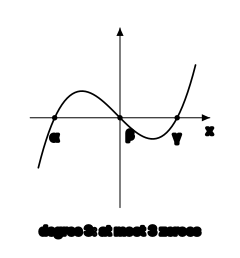
- Zero of a polynomial
- A value of x for which p(x) = 0. Geometrically it is the x-coordinate of a point where the graph crosses the x-axis.
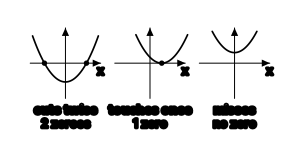
- Zeroes from a graph
- The number of times the curve cuts the x-axis equals the number of real zeroes; a curve that misses the axis has none.
- Sum and product of zeroes (quadratic)
- For ax² + bx + c the zeroes add to −b/a and multiply to c/a, so a quadratic can be built from its zeroes.
- Forming a quadratic from its zeroes
- Given the sum s and product p of the zeroes, the polynomial is k[x² − sx + p] for any non-zero k.
- Zeroes of a cubic
- For ax³ + bx² + cx + d the zeroes satisfy α+β+γ = −b/a, αβ+βγ+γα = c/a and αβγ = −d/a.
- Division algorithm for polynomials
- For polynomials p(x) and g(x) ≠ 0, p(x) = g(x)·q(x) + r(x), where the remainder r(x) has degree less than g(x).
- Long division of polynomials
- Divide the leading terms, multiply back, subtract and repeat — arranging both polynomials in descending powers first.
- Using a known zero to factorise
- If α is a zero then (x − α) is a factor, so dividing by it reduces a cubic to a quadratic that can be solved normally.
Start this chapter free
You have 6 to try above. Sign in with Google (no card needed). You get 1 Easy + 1 Medium quiz on every chapter, free for good (up to 6 quizzes a day) — plus a free Hard quiz when you score 70%+ on a Medium quiz (1 per subject), and the formulas & exam tips.
This chapter has 108 questions (31 Easy · 39 Medium · 38 Hard), with timed scoring and instant feedback. The rest unlock with the ₹999/year plan.
Start with the questions above. The full quiz opens here after.
Polynomials — FAQs
What are the key concepts in Class 10 Mathematics Polynomials?+
A polynomial's zeroes are where its graph meets the x-axis, and they are tied to its coefficients by fixed relationships. This chapter reads zeroes off a graph, links them to the coefficients for quadratics and cubics, and divides one polynomial by another. Key ideas include Polynomial and its degree, Linear, quadratic and cubic, Zero of a polynomial, Zeroes from a graph, Sum and product of zeroes (quadratic), Forming a quadratic from its zeroes.
What does Class 10 Mathematics Chapter 2 (Polynomials) cover on XamBaaz?+
It has 108 NCERT-based MCQs on "Polynomials": 31 Easy, 39 Medium and 38 Hard. Together they make 11 timed quizzes, and you never get the same set twice. Every question has an instant explanation. They help you prepare for CBSE Board exams and the JEE & NEET foundation years.
Are these "Polynomials" questions free to practise?+
Yes. Sign in with Google to practise "Polynomials" free. Full unlimited access is ₹999/year. One year from the day you pay. You stay in Class 10 till 31 March; on 1 April your account moves up to Class 11 and the rest of your year carries over. No chapter is charged separately.
How should I revise "Polynomials" for the exam?+
Start with the Easy quiz to check your basics, then try Medium and Hard to practise applying them. There are 11 timed quizzes on this chapter, so you can come back for a fresh set instead of one you have seen. Read each explanation, retry the questions you miss, and track your accuracy until it stays high.
Are these "Polynomials" MCQs available with answers?+
Yes. 6 sample questions are on this page with answers: tap an option, or "Show answer", to see the correct option and a step-by-step explanation. Sign in free with Google to start practising, with instant scoring.
Is there negative marking in the "Polynomials" quizzes?+
Yes. The timed quizzes use exam-style marking: +4 for a right answer, −1 for a wrong one and 0 for a skip. MHT-CET and CBSE board papers have no negative marking. Our mocks for those are scored their way.
What are the important questions from Polynomials (Class 10 Mathematics)?+
The questions that matter most test Polynomial and its degree, Linear, quadratic and cubic, Zero of a polynomial, Zeroes from a graph, Sum and product of zeroes (quadratic), Forming a quadratic from its zeroes. This page shows 6 solved important MCQs with answers and explanations. Sign in to practise all 108 questions on the chapter as timed quizzes.
Is there an online quiz for Polynomials?+
Yes — Class 10 Mathematics Polynomials has timed online quizzes at Easy, Medium and Hard levels, with instant scoring and a worked explanation on every question. The first quiz on the chapter is free.
Are there question answers and extra questions for Polynomials (Class 10 Mathematics)?+
Yes. This page has 6 solved questions on Polynomials, each with the correct answer and a short explanation. Sign in to practise all 108 questions on the chapter as timed quizzes.
Are there assertion–reason and case study questions for Polynomials (Class 10 Mathematics)?+
Yes. The Polynomials question bank has 6 assertion–reason questions and 12 case-based (case study) questions in the CBSE board format, alongside the regular MCQs. Each comes with the answer and a worked explanation. Sign in to practise them in timed quizzes.