
Conic Sections — Class 11 MCQs with Answers
Class 11 CBSE Mathematics · Chapter 10
133 practice questions · 33 Easy · 50 Medium · 50 Hard · Updated
Jump to the 6 solved questions
Practise the most important Class 11 CBSE Mathematics questions from Chapter 10, "Conic Sections". You get 13 timed quizzes made from 133 NCERT-based MCQs, with answers and explanations. The questions are split into 33 Easy, 50 Medium and 50 Hard. Warm up on the basics, then move on to the exam-level questions that top scorers in CBSE & Maharashtra HSC Board exams, JEE Main, MHT-CET and JEE Advanced get right.
To score well in "Conic Sections", focus on fast problem-solving, formula recall and step-by-step working. Each MCQ here is timed and uses exam-style marking (+4 correct, −1 wrong, 0 skipped). This helps you stay accurate when time is short, just as real papers need. Every question has a short explanation, so a wrong answer becomes a quick lesson. It is the fastest way to fix gaps before a test.
Use this chapter for focused revision. Start with the Easy set to check your basics on Conic Sections, then move to Medium and Hard to practise applying them. Your accuracy, streaks and XP save automatically. This chapter also adds to your overall Class 11 Mathematics mastery score. Try the 6 sample questions below: tap an option to see the answer and a worked explanation. Sign in free to start practising.
Conic Sections — important questions & MCQs with answers (Class 11 Mathematics)
6 solved questions from this chapter's difficulty levels, each with its answer and explanation. Tap an option to check yourself.
0 of 6 answered
- Q1 of 6Easy
Equation of circle centre (0,0), radius r:
Show answerHide answer
Answer: x²+y²=r²
Explanation: Every point stays a fixed distance r from the centre, and squaring that distance gives x²+y²=r² — squaring both sides is the step everyone forgets, which is why x²+y²=r (missing the square on r) tempts.
- Q2 of 6Easy
A circle is the set of all points:
Show answerHide answer
Answer: Equidistant from a fixed point
Explanation: A circle is the locus of points at a fixed distance (the radius) from one fixed point (the centre) — an ellipse instead keeps the SUM of distances to two foci constant, a definition students often blend with this one.
- Q3 of 6Medium
Focus of parabola y² = 12x:
Show answerHide answer
Answer: (3, 0)
Explanation: 4a=12 gives a=3, and the focus of y²=4ax sits at (a,0)=(3,0) — mixing up focus and directrix would instead give x=−3.
- Q4 of 6Medium
Assertion (A): For the ellipse x²/16 + y²/25 = 1, the major axis lies along the x-axis. Reason (R): In the standard equation of an ellipse, the major axis is along the axis of the variable that has the larger denominator.
Show answerHide answer
Answer: A is false but R is true
Explanation: R is true (NCERT observation 2). Here the larger denominator, 25, is under y², so the major axis lies along the y-axis. Hence A is false.
- Q5 of 6Hard
For hyperbola x²/16 − y²/9 = 1, length of conjugate axis:
Show answerHide answer
Answer: 6
Explanation: b²=9 gives b=3, and the conjugate axis is 2b=6 — the transverse axis 2a=8 is a different, tempting number since a²=16.
- Q6 of 6Hard
Assertion (A): An equilateral triangle is inscribed in the parabola y² = 4ax with one vertex at the vertex of the parabola. The length of each side of the triangle is 8√3a. Reason (R): The other two vertices of this triangle are the end points of the latus rectum of the parabola.
Show answerHide answer
Answer: A is true but R is false
Explanation: By symmetry the two sides from the origin make 30° with the axis, so one side lies on y = x/√3. Putting this in y² = 4ax gives x²/3 = 4ax, so x = 12a and y = ±4√3a. Each side is 2 × 4√3a = 8√3a, so A is true. These vertices lie on x = 12a, but the latus rectum lies on x = a, so R is false.
Conic Sections notes: key concepts (Class 11 Mathematics)
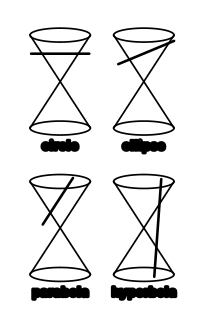
Slicing a double cone gives the conic sections: circle, parabola, ellipse and hyperbola. This chapter derives each standard equation and defines eccentricity e as the number that classifies them — 0 for a circle, below 1 ellipse, 1 parabola, above 1 hyperbola — then locates the foci, directrices and latus rectum.
- Conic sections
- Curves formed when a plane cuts a double right circular cone; the tilt of the plane produces a circle, ellipse, parabola or hyperbola.
- Circle
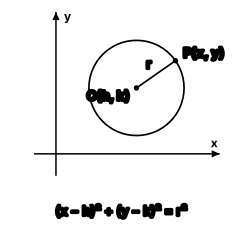
- The locus of points at a fixed distance r (the radius) from a fixed centre (h, k); its equation is (x − h)² + (y − k)² = r².
- Eccentricity
- The ratio e measuring how far a conic departs from a circle: 0 for a circle, e < 1 ellipse, e = 1 parabola and e > 1 hyperbola.
- Parabola
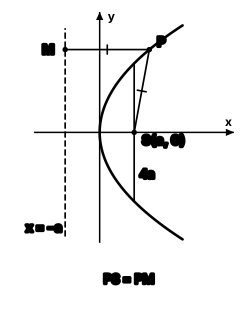
- The locus of points equidistant from a fixed focus and a fixed directrix; the standard form y² = 4ax opens rightward with e = 1.
- Parabola focus and directrix
- For y² = 4ax the focus is (a, 0), the directrix is x = −a, the axis is the x-axis and the latus rectum has length 4a.
- Four parabola orientations
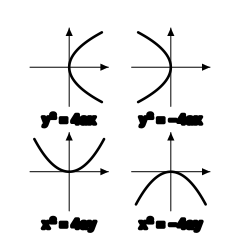
- y² = 4ax, y² = −4ax, x² = 4ay and x² = −4ay open right, left, up and down respectively, each with its vertex at the origin.
- Ellipse
- The locus where the sum of distances from two foci is constant; x²/a² + y²/b² = 1 with a > b, e < 1 and foci on the major axis.
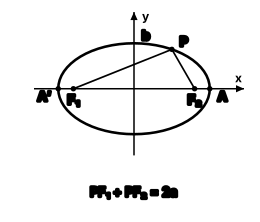
- Ellipse parameters
- For x²/a² + y²/b² = 1 with a > b, the relation b² = a²(1 − e²) holds, foci are (±ae, 0) and the latus rectum is 2b²/a.
- Hyperbola
- The locus where the difference of distances from two foci is constant; x²/a² − y²/b² = 1 with e > 1 and foci beyond the vertices.
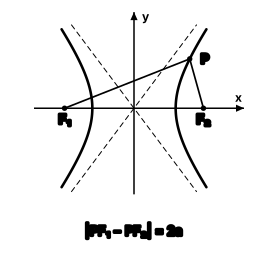
- Hyperbola parameters
- For x²/a² − y²/b² = 1 the relation b² = a²(e² − 1) holds, foci are (±ae, 0) and the latus rectum length is 2b²/a.
- Latus rectum
- The focal chord perpendicular to the conic's axis (the major axis of an ellipse, the transverse axis of a hyperbola); it measures 4a for y² = 4ax and 2b²/a for an ellipse or a hyperbola.
- Degenerate conics
- When the cutting plane passes through the cone's apex, the section collapses to a point, a single line or a pair of intersecting lines.
Start this chapter free
You have 6 to try above. Sign in with Google (no card needed). You get 1 Easy + 1 Medium quiz on every chapter, free for good (up to 6 quizzes a day) — plus a free Hard quiz when you score 70%+ on a Medium quiz (1 per subject), and the formulas & exam tips.
This chapter has 133 questions (33 Easy · 50 Medium · 50 Hard), with timed scoring and instant feedback. The rest unlock with the ₹1,999/year plan.
Start with the questions above. The full quiz opens here after.
Conic Sections — FAQs
What are the key concepts in Class 11 Mathematics Conic Sections?+
Slicing a double cone gives the conic sections: circle, parabola, ellipse and hyperbola. This chapter derives each standard equation and defines eccentricity e as the number that classifies them — 0 for a circle, below 1 ellipse, 1 parabola, above 1 hyperbola — then locates the foci, directrices and latus rectum. Key ideas include Conic sections, Circle, Eccentricity, Parabola, Parabola focus and directrix, Four parabola orientations.
What does Class 11 Mathematics Chapter 10 (Conic Sections) cover on XamBaaz?+
It has 133 NCERT-based MCQs on "Conic Sections": 33 Easy, 50 Medium and 50 Hard. Together they make 13 timed quizzes, and you never get the same set twice. Every question has an instant explanation. They help you prepare for CBSE & Maharashtra HSC Board exams, JEE Main, MHT-CET and JEE Advanced.
Are these "Conic Sections" questions free to practise?+
Yes. Sign in with Google to practise "Conic Sections" free. Full unlimited access is ₹1,999/year. One year from the day you pay. You stay in Class 11 till 31 March; on 1 April your account moves up to Class 12 and the rest of your year carries over. No chapter is charged separately.
How should I revise "Conic Sections" for the exam?+
Start with the Easy quiz to check your basics, then try Medium and Hard to practise applying them. There are 13 timed quizzes on this chapter, so you can come back for a fresh set instead of one you have seen. Read each explanation, retry the questions you miss, and track your accuracy until it stays high.
Are these "Conic Sections" MCQs available with answers?+
Yes. 6 sample questions are on this page with answers: tap an option, or "Show answer", to see the correct option and a step-by-step explanation. Sign in free with Google to start practising, with instant scoring.
Is there negative marking in the "Conic Sections" quizzes?+
Yes. The timed quizzes use exam-style marking: +4 for a right answer, −1 for a wrong one and 0 for a skip, the same negative marking as JEE Main and JEE Advanced. MHT-CET and CBSE board papers have no negative marking. Our mocks for those are scored their way.
What are the important questions from Conic Sections (Class 11 Mathematics)?+
The questions that matter most test Conic sections, Circle, Eccentricity, Parabola, Parabola focus and directrix, Four parabola orientations. This page shows 6 solved important MCQs with answers and explanations. Sign in to practise all 133 questions on the chapter as timed quizzes.
Is there an online quiz for Conic Sections?+
Yes — Class 11 Mathematics Conic Sections has timed online quizzes at Easy, Medium and Hard levels, with instant scoring and a worked explanation on every question. The first quiz on the chapter is free.
Are there question answers and extra questions for Conic Sections (Class 11 Mathematics)?+
Yes. This page has 6 solved questions on Conic Sections, each with the correct answer and a short explanation. Sign in to practise all 133 questions on the chapter as timed quizzes.
Are there assertion–reason and case study questions for Conic Sections (Class 11 Mathematics)?+
Yes. The Conic Sections question bank has 13 assertion–reason questions and 30 case-based (case study) questions in the CBSE board format, alongside the regular MCQs. Each comes with the answer and a worked explanation. Sign in to practise them in timed quizzes.